December 12, 2009

25: The Name Game

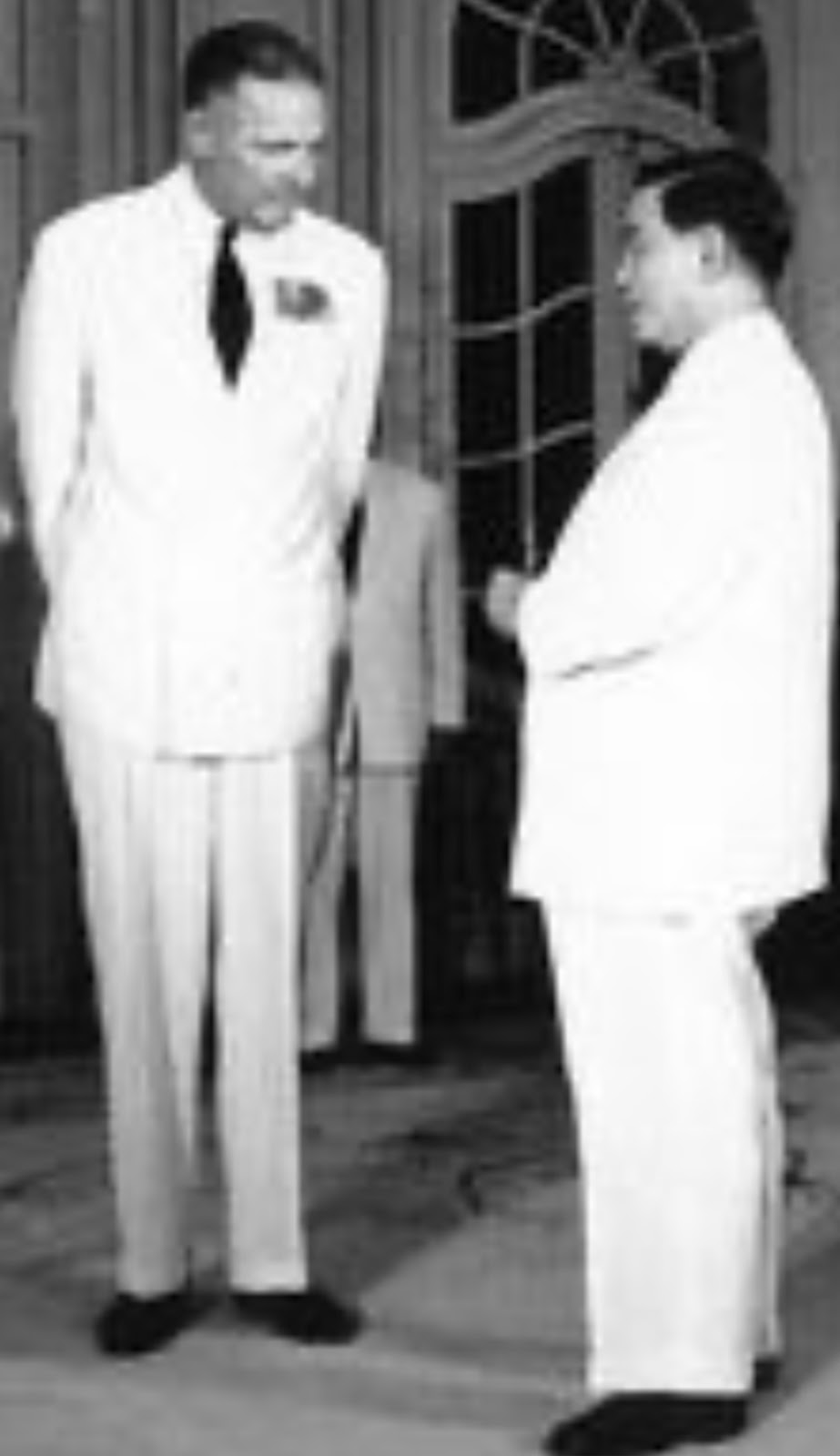
In the past, Pawley would go straight to the top to argue his position to Presidents Roosevelt, Truman or Eisenhower when he felt that his dealings with underlings were not going well. But in the new Kennedy administration, he did not have that access, so he had to take his case to Assistant Secretary of State Thomas Mann (photo), whom weeks earlier Pawley had praised as “brilliant” and no “nicer fellow” while chastising him for his friendship with Betancourt.1

Pawley in early March 1961 began sending Mann materials to make the case against Manuel “Manolo” Ray and for the use of others.2 Ray was a former professor of engineering at the University of Habana, who had been selected by the CIA to rally support. Pawley disliked him because he had served as Castro’s Minister of Public Works, although he quit the Castro cabinet position after his friend Huber Matos was arrested by Castro. Ray then defected to the U.S. and became the leader of the anti-Castro counterforce People’s Revolutionary Movement (MRP).3

In the letter to Assistant Secretary of State Thomas Mann, Pawley demonstrated his mastery of the Cuban situation while raising the possibility of a post-Castro civil war if the wrong leaders are selected. “It [is] also thought by important Cubans whom I know here that Ray and three or four of the other prominently mentioned Cubans have already made arrangements through Russian agents and that when Castro falls, Russia will still have their men in power even though they pretend to demonstrate a more friendly attitude toward the United States.” Pawley stated “that the best solution would be a ‘junta’ or ‘frente’ made up of leaders of the various political groups. At no time has this seemed more necessary than now.” He offered four names for this role: de Varona, Carillo, Artime, and Maceo.

Read more »

Labels: , , , , , , , , , , , , , , , , , ,

26: Days of Swine and Rose's Boys: Bay of Pigs Invasion

Fear of retaliation was a concern as the CIA planned the demise of two Western Hemisphere leaders, Castro and Trujillo. According to the CIA’s Deputy Director for Support, Col. L.K. White, on March 22, 1961, the CIA’s Sheffield Edwards and Jack Earman met with CIA Deputy Director General Charles Cabell “to point out to them that we were not furnishing the Director the personal protection which we should be furnishing in these critical times.”1

On April 4, 1961, President John F. Kennedy, the first Catholic president whose mother, Rose, prayed the rosary throughout his life, heard about the “immorality” of an invasion of Cuba voiced by Senator William Fulbright, chairman of the Senate Foreign Relations Committee. While Fulbright “denounced the proposition out of hand,” Adolphe Berle declared his belief that “a ‘power confrontation’ with Communism in the Western Hemisphere was inevitable.” Assistant Secretary of State for Inter-American Affairs Thomas C. Mann, “who previously had been on the fence, now spoke up for the operation.”2 Rose’s son’s march toward disaster proceeded headlong with the momentum created by Pawley-intelligence-exile axis.

Pawley on April 15th sat down with FBI agents Leman L. Stafford, Jr. and George E. Davis, Jr. for an interview that Pawley had requested. He let them know he was “a personal friend of the Director of the FBI, as well as of President Eisenhower, former President Truman and many other influential people in the United States and Latin America.” Pawley then voiced “that he is deeply concerned about the communist trend in Cuba and its effects on other Latin American countries, and that he has been in close contact with the U.S. State Department and the CIA relative to the situation.”3

Manuel Ray Rivero “took the view that the internal resistance was so strong that Castro could be overthrown without an ‘invasion’ from the outside.” (In truth, there was only insignificant damage from the 110 insurgent bombings between October 1960 and April 17, 1961,4 when Jose A. Perez “Pepe” San Roman led the Bay of Pigs invasion.)5

Ray’s wishy-washy stance on the need for an invasion did not sit well with Pawley, and in the weeks before the invasion Ray complained that assertions that he favored Cuba maintaining relations with the U.S.S.R. “were not true and part of a ‘campaign against him by Mr. Pawley of the Miami City Transit Company.’”6

Despite the desire to make it look like a Cuban led invasion, among the first men ashore were two non-Cubans, Grayston L. Lynch (aka Gray) and William “Rip” Robertson, who had been among those suggested as possible assassins of Castro. Lynch, a fearless veteran of the D-Day invasion at Normandy Beach, the Battle of the Bulge, and Heartbreak Ridge in Korea, would survive the debacle at the Bay of Pigs and go on to direct and participate in hundreds of more clandestine operations against Cuba. A decade before dying in 2008, Lynch published his account of the invasion imbued with anger at the failure of the Kennedy Administration to provide the essential air cover titled Decision for Disaster: Betrayal at the Bay of Pigs. Rip Robertson’s passion for adventure ended a decade later when he “died in 1973 of malaria in Laos.”7

Read more »

Labels: , , , , , , , , , , , , , , , ,

27: Brigade 2506 Hostage Negotiations

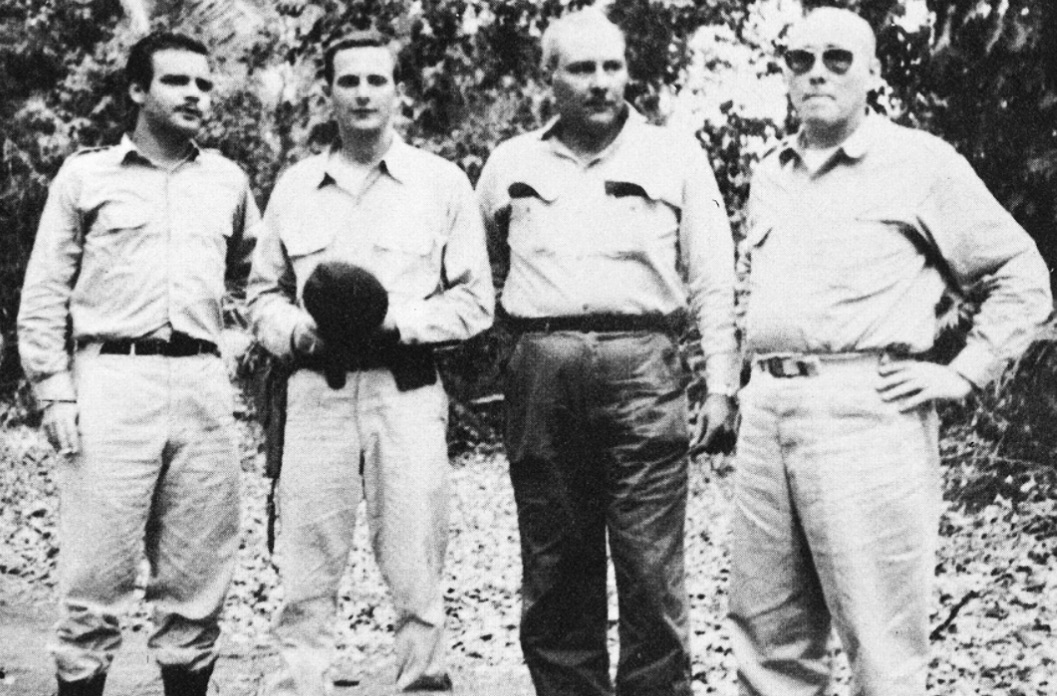
Within a month of the disastrous Bay of Pigs invasion, William Douglas Pawley found a new leadership role for himself—negotiating the release of the Brigade 2506 members and their political leader Manuel Artime (far left in photo next to the invasion ground Commander Jose Perez "Pepe" San Roman, the CRC's Antonio Maceo, and DRE founder Manuel Antonio de Varona).
1                                                                    
Pawley along with Assistant Director of Immigration and Naturalization Lou Gidel and representatives of the FRD met on May 20, 1961, at the home of Cuban Revolutionary Council (CRC) leader Dr. Jose Miro Cardona whose knowledge of Cuban law was grounded in being the former President of the Cuban Bar Association. Also in attendance was Christian Democratic Movement (MDC) leader Jose Ignacio Agusto Rasco Bermudez (cryptonym AMPALM-5) who had been president of his university’s debating society.

While the CRC was meant to unite the various Cuban exile factions, an odd wedge appeared less a year later when Dr. Miro received a letter from Madrid, Spain written to newspaperman Norman Diaz. “I am sending you these lines to acquaint you with the fascist movement which was founded in Spain and Italy and called Opus Dei which is moving in the political sphere of the political refugees in Miami.” The movement of “industrialists, merchants, professional people and elements of the extreme right” is close to Franco and “in Miami is represented by Fernandez Varela, the ‘little priest’” who is struggling “for control of the organization” with “Dr. Lasaga, who is a member of the Revolutionary Council in Miami.” The DRE “whose base is the University [of Havana] Catholic action, is involved in the fascist organization and its representatives in Miami.” Dr. Miro told his CIA contact that he “looked upon this letter as merely speculation of one person.”2

Richard Scully Cain (aka Richard Scalzetti), a former Chicago policeman turned private eye “was hired as a bodyguard for Jose Rasco during a visit to Chicago.” Months earlier, Cain had contacted the CIA’s Chicago Domestic Contact Division “Field Office and voluntarily provided information on the activities of Cuban exile groups in the Chicago area.” Following his service to Rasco, in April 1962, “Cain made an unannounced visit to Agency representative Winston Scott and Warren Dean in Mexico City” and claimed he was providing “police training to Mexican Government agents.” Two months later he was deported “for carrying a loaded revolver and brass knuckles, impersonating a Mexican Government official, and violating his tourist permit by working.”

At the May 1961 Rasco/Cardona meeting, attendees “chose spokesman on spot. Pawley will identify later.” They learned that Castro “said that feeding and housing 1214 prisoners plus 800 guards was heavy economic burden he wished to shed” in exchange for multiple ferryloads of tractors and spare parts that would last five years, a burdensome process Miro proposed to avoid Castro reneging on the agreement. “Pawley suggested to Miro this process might be streamlined and speeded by letting Canadian gov’t supervise exchange.”

After the meeting, Pawley heard the delegates comment that the brigade prisoners “are proud to have fought in the first armed battle of the free world against communism” and desire “to go back again with the experience and self-confidence they have gained from the invasion.” And despite their quick capture, Pawley reported that the “Training they received in camps and execution of amphibious landing were superb.”3

Luce’s Time magazine reported on June 2, 1961, that Castro’s ransom demand included heavy tractors. To pay for them, JFK urged former first lady Eleanor Roosevelt, United Auto Workers' President Walter Reuther and Dr. Milton Eisenhower to do fundraising. William D. Pawley contributed $25,000. On the West Coast, John (“Jake the Barber”) Factor of Los Angeles, “a Prohibition-era hoodlum who got kidnaped [sic] by other hoodlums in 1933 and knows all about ransoms sent $25,000.” But not everyone thought it was a good idea. Connecticut's Democratic Senator Thomas Dodd worried that paying ransom would create a ripple effect leading to the Communists seizing a billion. Time painted the image of Castro pleasurably “guffawing through his beard.”4

Read more »

Labels: , , , , , , , , , , , , , , ,

28: Cuba Cacophony: Northwoods, Mongoose, JMWAVE and DRE

Nearly a year after the Bay of Pigs disaster, Secretary of Defense Robert S. McNamara received a memo from the Chairman of the Joint Chiefs of Staff Lyman Lemnitzer (pictured left of JFK next to General Curtis LeMay) on the topic of “Justification for U.S. Military Intervention in Cuba (TS).”


The March 13, 1962 proposal appears to be heavily influenced by the “more ruthless than the enemy” attitude of the Doolittle Committee report. 

It suggested ways to justify to the American public an all-out war on Cuba. It brought Operation Mongoose to a new level of activity outside the borders of Cuba with recommendations that included assassinating anti-Castro Cuban refugees living in Miami or sinking a boatload of refugees escaping the island and blaming it on Castro by using false documents. The most horrific suggestion was faking a Cuban air force attack on a civilian jetliner or blowing up a U.S. ship in Cuban waters and then blaming the incident on Castro-planned sabotage, similar to the “Remember the Maine” incident which justified the U.S. entry into the Spanish American War some six decades earlier.

The justification memo also noted that the project should be undertaken “in the event that current covert efforts to foster an Internal Cuban rebellion are unsuccessful” and “a credible internal revolt is impossible of attainment during the next 9-10 months ... It is understood that the Department of State also is preparing suggested courses of action to develop justification for U.S. military intervention in Cuba.”

The JCS members who put their names to it in addition to Lemnitzer were (to the right of JFK) General George Henry Decker (Chief of Staff, U.S. Army); Admiral George Whelan Anderson Jr. (Chief of Naval Operations); and General David Monroe Shoup (Commandant, U.S. Marine Corps). 

General Curtis Emerson LeMay (Chief of Staff, U.S. Air Force) would become as vociferous a hawk on the issue of Cuba as Pawley, and in October President Kennedy would replace Lemnitzer with General Maxwell Taylor.1 

William Bamford, an expert on the National Security Agency who revealed the document in his 2001 book Body of Secrets, stated that Operation Northwoods “may be the most corrupt plan ever created by the U.S. government.” What’s more amazing is that the proposal was made three weeks after Robert Kennedy had told Air Force General Edward G. Lansdale, the Pentagon’s Deputy Director of the Office of Special Operations (OSO), to focus on intelligence gathering instead of proposing wildly outrageous schemes for Operation Mongoose, which was originally developed by the JCS and Lansdale to foment a revolt within Cuba to overthrow Castro. 

On April 11, 1962, General Lansdale provided a report on the “Status of Operation Mongoose” at week four of the 19-week Phase 1. “Our Center in Miami processed 1,309 refugees last week ... McCone can provide details” of “debriefing visitors to Cuba, at a number of free world ports.” 

Read more »

Labels: , , , , , , , , , , , , , , , , , , ,

32: "What it is ain't exactly clear"*

On October 4, 1963, The New York Times reported that Republican conservative candidate for President Barry Goldwater believed President Kennedy was helping the Soviets. The President was considering a wheat sale to the Russians, which former Vice President Nixon also spoke adamantly against asserting it would be “harming the cause of freedom.”1

Six days later, asserting it was good for the US economy, JFK announced his approval of the $250 million wheat sale to the Soviet Union while ruling out sales to Cuba and China. A schism between Red China and Russia had appeared at about the same time, and the intelligence and defense communities would debate whether it was real and or a treacherous ploy to deceive the United States.2

The President issued a denial that the CIA was pursuing an independent course in South Vietnam where a “serious disagreement over United States policies” had developed “between Ambassador Henry Cabot Lodge and the head of the Central Intelligence Agency there.” The New York Times had reported “that Mr. Lodge would be happier with a new C.I.A. chief.”3  The 6' 3" tall Lodge, also felt that South Vietnam President Ngo Dinh Diem should be overthrown by the country’s military because of his harsh treatment of the nation's Buddhists.4

Read more »

Labels: , , , , , , , , , , , , , , , , , , ,

34: The Warren

The November 22, 1963, 12:30 pm (CST) JFK assassination was quickly painted as the act of a disgruntled loner with a communist taint who expertly picked off his target as President Kennedy traversed past Dealey Plaza moving away on a downward curving road from the sniper's nest on the 6th Floor of the Texas School Book Depository. 

Within 48 hours of the shooting, the alleged shooter, Lee Harvey Oswald, was shot by Jack Ruby who owned The Carousel nightclub, a strip-tease joint strategically located across from the popular Dallas hotel, The Adolphus. Ruby's club not only was frequented by tourists as well as local politicians and businessmen but also by members of the Dallas Police Department. The policemen not only came to imbibe in drinks and titillation but often were employed by Ruby as security guards. This fact created the possibility of a complex conspiracy. 

Who was Lee Harvey Oswald? https://www.pbs.org/wgbh/frontline/article/twenty-four-years/

Did Ruby know Oswald? Did a Dallas cop tipoff Ruby or expedite Ruby's ability to enter the Dallas Police Department basement on November 24th at 12:20 pm, precisely when Oswald was in the process of being transferred to the county jail? Was Ruby connected to any mob boss—Joseph Civello in Dallas, Sam Giancana in Chicago or Carlos Marcello in New Orleans—who had put out a hit on Oswald?   

Oswald’s death triggered U.S. Deputy Attorney General Nicholas Katzenbach to write a memo to President Johnson's aide Bill Moyers, stating: "The public must be satisfied that Oswald was the assassin that he did not have confederates who are still at large and that evidence was such that he would have been convicted at trial." 

Katzenbach emphatically insisted on a coverup: "Speculation about Oswald’s motivation ought to be cut off and we should have some basis for rebutting thought that this was a Communist conspiracy or (as the Iron Curtain press is saying) a right-wing conspiracy to blame it on the Communists. Unfortunately the facts on Oswald seem about too pat—too obvious (Marxist, Cuba, Russian wife, etc.). The Dallas police have put out statements on the Communist conspiracy theory and it was they who were in charge when he was shot and thus silenced." Katzenbach wanted the Assistant FBI Director Cartha DeLoach to declare Oswald acted alone and suggested that it may become necessary for President Johnson to appoint a blue ribbon panel to prevent Congressional hearings that may arrive at a different conclusion.  

But even FBI Director J. Edgar Hoover had a problem. He told President Johnson that there was a very confusing angle about Oswald's visits to the 
Soviet Embassy in Mexico City between September 27 and October 2, 1963. 

"We have up here the tape and the photograph of the man who was at the Soviet Embassy using Oswald’s name. That picture and the tape do not correspond to this man’s voice nor to his appearance."  

In response to the FBI's inquiry to the CIA about the Agency's knowledge about Oswald, Birch O’Neal of the Counterintelligence Staff  replied “there was nothing on him in CIA file other than material filed furnished to CIA by FBI and Department of State.” In fact, however, the CIA's Special Investigations Group had been monitoring Oswald since November 1959 and within its dozen Oswald documents was a report that Oswald was in contact with the diplomatic offices of the Soviet Union and Cuba. Hoover wanted the FBI's legal attaché in Mexico City to look into the possibilities of a fake Oswald and Russian involvement.

For those who began decades of exploring Oswald-Ruby connections, it was a journey that entered a labyrinth that went around the world to Japan and Russia and back to the U.S. and Mexico; what emerged from the warren left many questioning why LBJ's "unimpeachable" Warren Commission left out of its investigation so many unusual connections. 

In the decades that followed, the Rockefeller Commission, House Select Committee on Assassinations and Church Committee would look into the connections and classify much of what they found. Sixty years later, thousands of declassified CIA, FBI, State, Army and other documents were still trickling out, and some documents such as those about the DRE’s CIA case officer, George Joannides, whose name did not surface until a half-century after the Bay of Pigs invasion, were still being withheld.

A lawsuit by reporter Jefferson Morley led to a court decision in December 2007 regarding declassification of documents relating to Joannides involvement with the DRE, the group that interacted with Oswald. Jefferson Morley wrote in The Washington Independent, that a circuit court had “ordered the CIA to search its operational files for more material on Joannides” and “explain why 17 reports on Joannides’ secret operations in 1962, 1963 and 1964, are missing from CIA archives. In legal briefs, agency officials have claimed that more than 30 documents about Joannides’s actions in the 1960s and 1970s cannot be made public in any form—for reasons of ‘national security.’”

The suit had been filed after it was learned that Joannides in the 1970s had become the CIA liaison carrying requested documents pertaining to Oswald’s possible co-conspirators from the Agency to the House Select Committee on Assassination (HSCA).

Read more »

Labels: , , , , , , , , , , , , , , ,

35: Our only hope, Goldwater

On March 6, 1964, a splintering of Pawley’s clout in the Florida Republican Party was revealed. Pawley’s favored candidate, conservative Barry Goldwater--whom Pawley believed was "our only hope" for the nation-- “expressed himself as not being ‘overly concerned’ with the Florida intra-party struggle. Nevertheless, there is bad blood in Florida Republican ranks, and it could hurt Barry,” reported the Muscatine Journal.

Clifton White and Richard Kleindienst were sent by Goldwater to Tampa to smooth things over. “When Barry Goldwater landed in Palm Beach, he was handed a memo from, a close adherent of Basil LaVergne, head of the Draft Goldwater movement in Florida. The memo was a petition for Barry Goldwater to step in and appoint somebody with the authority to force both Brown and Cramer into line. William D. Pawley, “one of the most respected Florida Republicans” was mentioned as one possibility: Victor Hruska, vice president of the Prudential Insurance Company of Jacksonville, was another.

It was a sticky situation for Goldwater because Pawley and Hruska had already been approved by Brown, “and Goldwater could hardly undercut Grenier, his southern regional director, without causing bad blood in Alabama and Mississippi.”

The Florida conservatives believed that LBJ would lose because “Lyndon Johnson hurt himself on his appearance in Florida last week when he skipped over the dubious constitutionality of some features of the civil rights bill.”1

On March 25, 1964, the FBI reported on its interrogation of Dr. Fernando Penabaz Coburn, a Duke graduate who became a Cuban lawyer before fleeing to Miami in 1960 and becoming a newspaper writer and anti-Castro propagandist at JMWAVE. Like others in Miami’s anti-Castro milieu, Penabaz claimed Oswald had connections to Castro. 

While attending “the Third Annual National Anti-Communist Leadership School, sponsored by the Christian Crusade,” Penabaz met with its founder, evangelical Reverend Billie James Hargis who spread his message on hundreds of radio and TV stations across America. “Dr. Penabaz stated that during the period of his visit at Shreveport, [February 1964] he recalled having a visit in the room of the Reverend Hargis, at which General Edwin Walker was present.” Regarding the topic of the JFK assassination, “Dr. Penabaz stated he probably did say that one could argue in favor of the thesis that Castro may have had reasons to eliminate President Kennedy,” because “President Kennedy wanted him deposed as the leader in Cuba.” In fact, in September 1963, “Castro virtually threatened President Kennedy by a statement to the effect that leaders threatening him (Castro) better be careful, because they, too, could suffer accidents.” Penabaz even claimed there was a cartoon in a Cuban newspaper showing Castro laughing over a dead Kennedy shortly before the assassination—but the FBI found no copy of it.

Penabaz told his FBI interrogator he was unaware of the article in William F. Buckley’s National Review that asserted a reporter at The New York Times “had obtained from a very good source the story of Oswald’s trip to Mexico and subsequent return to the United States with the sum of $10,000, but that the Times “mysteriously withheld the story.” Months earlier, Clare Boothe Luce had used her good friend Buckley’s National Review to denounce Kennedy.2

“With respect to information that Oswald, on return from his alleged trip to Cuba, was accompanied by Quintin Pino [Machado], who was to take Oswald to Cuba after the assassination, Dr. Penabaz stated he had not made such a statement to anyone as being fact. He stated that he had heard [from Miguel de Leon] of an alleged plot wherein Quintin Pino had crossed into Texas from Mexico for the purpose of rescuing Oswald.” Miguel “de Leon stated he had learned this while visiting the home of Cuban engineer Sixto Mesa about a week after the assassination” but could not recall who said it. Mesa “stated it was Dr. [Adolfo] Vilasuso who had related the story.” Yet, Dr. Vilasuso stated he possessed no authentic information.

Dr. Penabaz denied to the FBI that he claimed “Oswald had been shot by Jack Ruby for failing to follow the escape plan after the assassination” but “may have said that such a possibility existed.”3 During a television interview on December 5, 1963, Penabaz had also claimed Jack Ruby was a communist.4 Coincidentally, Penabaz knew the DRE’s Carlos Bringuier whose interactions with Oswald on the streets of New Orleans helped paint him as a communist.5

Read more »

Labels: , , , , , , , , , , , ,

37: Garrison's Gumbo


In 1966, New Orleans District Attorney Jim Garrison (foreground in photo with Clay Shaw) began probing a possible connection between the CIA and the Kennedy assassination. Some observers hoped it would be a way to feast on the truth, but for the CIA it was causing high-level indigestion.

On January 12, 1967, a CIA Dispatch from Chief, WOVIEW (Cord Meyer, Jr. of the Covert Action Staff), expressed concern that Garrison’s investigation was impugning the Warren Commission, President Johnson and the CIA. 

The document outlined how to counter criticism of the Warren Commission by discussing “the publicity problem with liaison and friendly elite contacts (especially politicians and editors), pointing out ... that parts of the conspiracy talk appear to be deliberately generated by Communist propagandists.” Moreover, “employ propaganda assets to answer and refute the attacks of the critics. Book reviews and feature articles are particularly appropriate for this purpose.” During “private or media discussion not directed at any particular writer” arguments should be made that: “No significant new evidence has emerged.” Eyewitnesses “are less reliable.” 

Robert Kennedy “would be the last man to overlook or conceal any conspiracy.” Republican “Congressman Gerald R. Ford would hardly have held his tongue for the sake of the Democratic administration” of Lyndon Johnson, “and Senator Russell would have had every political interest in exposing any misdeeds on the part of Chief Justice Warren. A conspirator moreover would hardly choose a location where so much depended on conditions beyond his control: the route, the speed of cars, the moving target, the risk that the assassin would be discovered. A group of wealthy conspirators could have arranged much more secure conditions.” Bold emphasis added by D.P. Cannon.

The CIA releasing officer’s signature on the document was Cord Meyer, Jr.1 whose wife’s mysterious death became interwoven in assassination conspiracy theories because of her affair with JFK--and James Jesus Angleton's retrieval of her diary after her body was discovered along the Georgetown canal towpath.

It's rather mind blowing that the Warren Commission which included ex-CIA Director Allen Dulles wanted Americans to believe a lone nut ex-Marine could pull off an assassination at Dealey Plaza, but a CIA executive who had worked under Dulles wanted Americans to believe it was too difficult for trained CIA assassins to do.

Read more »

Labels: , , , , , , , , , , , , , , , ,

42: Luce Lips

In 1956, Clare Boothe Luce was close enough to the Kennedy family that she received a postcard from JFK’s mother, Rose, written when Jackie and John lost a baby. “Pray—please—dear Clare.”1 

But in August of 1970, it was revealed that Henry Luce had voted a decade earlier for Richard Nixon—instead of John F. Kennedy—yet spent the night of the election with Joseph and Rose Kennedy and months later attended JFK’s inaugural.2

In August 1971, an article appeared in the Miami Herald detailing Pawley’s role in Operation TILT, the effort to extract Soviet missile technicians from Cuba and have them state missiles still existed on the island despite the Kennedy administration’s claim that the weapons had been removed. FBI Special Agent in Charge Francis M. Farrell attached the article to his memorandum noting that “Pawley has been of interest to our organization and its predecessor for many years.”3

In 1975, the Washington Star contacted Pawley for follow up to a story that had appeared in City, a short-lived San Francisco publication. City’s story had been co-authored by former FBI agent William Turner and Warren Hinckle, who had been with Ramparts magazine when the publication revealed CIA funding of foundations. The Washington Star story dealt with Operation TILT and reported that Pawley “said yesterday that Life joined the party and paid the commandoes in exchange for exclusive rights to the story.”4

Another account of the tale was published in the spring 1976 issue of Soldier of Fortune magazine. Written by Miguel Acoca, a former Life staff writer, and Robert K. Brown, the publisher of Soldier of Fortune, the exclusive article was titled “The Bayo-Pawley Affair: A Plot to Destroy JFK and Invade Cuba.” It was excerpted from Brown’s 1967 manuscript, Ripped Cloak, Rusty Dagger: JFK, LBJ and the CIA’s Secret War Against Castro. The article included photos taken by Terence Spencer, the Life photographer who accompanied the Bayo-Pawley operation part of the way.

The Soldier of Fortune article asserted that “Operation Red Cross” (a name created by Life) “was a plot to destroy President Kennedy politically, and the CIA played a major role— with “its agents, planes, ships and communications” involved.

Bayo, whose real name was Eduardo Perez, had earlier in the year been involved in a failed attempt “to topple Haiti’s President Francois Duvalier, the hated ‘Papa Doc’” believing that “Haiti was the ideal base for attacks against Cuba.” At one of the first planning meetings, Bayo met with Tony Questa and Ramon Font of Commando L, Mario Fontela of FORDC and “and the boys from DRE.”5 Other Bayo-Pawley planning meetings were attended by INTERPEN’s Frank Fiorini6 and Gerald Patrick Hemming.7

Pawley was interviewed briefly on October 15, 1975 for the Spring 1976 article and stated that he felt that the June 1963 Operation TILT was a “‘one-thousand-in one chance.’”8

As it turned out the odds were not even that good.

When CIA documents were finally declassified decades later they provided details including weapons and points of rendezvous for an operation that was plagued with problems. The radar was out of order and the “operation delayed twenty four hours due to engine trouble Mr. Pawley yacht.” His “Flying Tiger anchored at Point G” had to wait for a replacement part to make emergency repairs. “Bill, States intentions to continue operation independently unless unknown factors exist,” the “Op procedding [sic] as planned X due navigational difficulties involved.” Then there was loss of contact with the and the futile search for the missing TILT team members.9

A memo referring to QDDALE’s May 23 contact with JMWAVE Station Chief Reuteman detailed how John “Martino had tried to talk [Richard] Billings [of Life] out of participating in the Soviet defector operation but Billings had refused to be excused ... This resulted in QDDALE learning that Mr. George P. Hunt, Managing Editor of Life Magazine, planned to be in Miami 23 May” and “Life was willing to pay each of the Soviets $2500 for their story.”10

Richard Billings was not a mere employee. His father, John, had been the first managing editor of Life. Richard was part of the team that purchased the Zapruder film of the JFK assassination. A few years later, he endeared himself to New Orleans District Attorney Jim Garrison and Tom Bethal who were looking into Oswald’s associates in New Orleans. Months later, Life began questioning Garrison’s integrity.

In the next decade, Billings became the editorial director for G. Robert Blakey who was named chief counsel to the House Select Committee on Assassinations in September 1976. In the book, they co-wrote after the hearings ended, they concluded that Oswald and an unnamed shooter from the Grassy Knoll were part of a conspiracy organized by Carlos Marcello who ran the Southern mafia from New Orleans and had been deported by the Kennedy administration after the “underworld figure, was ruled an undesirable alien.”11

On October 25, 1975, after Pawley was interviewed about TILT, Life magazine’s Clare Boothe Luce called her friend CIA Director William Colby to try to explain how she was able to so very quickly identify Oswald as being pro-Castro. (Colby had overseen the CIA's covert activities in Italy when Luce was the U.S. Ambassador there two decades earlier and was trying to stop communists from taking over the country.) Luce's 1975 call to Colby took place as Senator Schweiker was reopening the Kennedy
assassination in wake of the Watergate Rockefeller hearings. The entire conversation, transcribed by Barbara Pindar along with her parenthetical notes, offers many insights into the Luce and Pawley mission, their DRE allies and associates, and her spin:

Mrs. Luce: I have a big problem, a case in conscience. I got rather deeply involved during and after the Bay of Pigs, and up to the time of the missile crisis, with a group called the (Directorate Revolutionario Estudiante; Barbara Pindar Note: the spelling of that is just a guess), the DRE. Whether you know this or not, it was me who fed the missile stuff to Keating. I knew a number of these leaders well; they were going in and out of Cuba, and I paid for one of the motor boats. Bill Pawley did too. We thought we were doing another Flying Tiger. The missile crisis came, and I got a telephone call from Allen telling me that the Secrets Act had gone into effect and that henceforth there would be no voluntary American efforts. That ended that, and I don't know what I was doing— maybe I went back to Arizona, or whatever. Then came the assassination. The night of the assassination, right after Oswald was caught, one of my boys telephoned me from New Orleans. Didn't I ever tell you this?

Read more »

Labels: , , , , , , , , , , , , , , , , ,

47: Timeline

1864 ~ Edward Porcher Pawley born.

1890 ~ Edward marries Mary Irene Wallace.

1893 ~ George Plummer Pawley born. 

1896/9/7 ~ William Douglas Pawley born in Florence, South Carolina.

1899 ~ After the Spanish American War when Teddy Roosevelts “Rough Riders” help liberate Cuba from Spain, Pawley spends his early childhood at Guantanamo Bay Naval Station where his father had a store, earning him the nickname “Cuba” from classmates at Gordon Military Academy in Georgia.

1925/5/20 ~ Gerardo Machado becomes the 5th President of Cuba. He is overthrown in 1933.

1928 ~ William Douglas Pawley creates Cubana National Airlines which is sold to Pan American Airlines in 1932.

1929 ~ China Airways financed by Curtiss-Wright and controlled by Clement M. Keys begins flying mail from Shanghai to Hankow, Peiping and Canton. With pressure from the government, it evolves into China National Aviation Corporation (CNAC).

1932 ~ William Pawley establishes Intercontinent Corporation run by him and his brothers Edward and Eugene.

1933 ~ Pawley becomes President of China National Aviation Corporation.

1936 ~ William's oldest brother, George Plummer Pawley, dies.

1940/12/23 ~ Pawley partners with India in establishing Hindustan Aircraft Limited near Calcutta (Bangalore).

1941 ~ Pawley begins China Aircraft Manufacturing Company CAMCO to manufacture planes for the American Volunteer Group (The Flying Tigers headed by General Clair Chennault) to defend Chiang Kai-shek’s Nationalists against Japanese planes. CAMCO airplane assembly plants moved from Hangzhou to Wuhan to Lowing (on the China-Burma border) to India. 

1941/9 ~ David Harold Byrd, wealthy oil man and owner of the Texas School Book Depository in Dallas, co-founds the Civil Air Patrol to watch for enemy submarines and border crossings as well as enemy aircraft over the U.S. and provide other civilian support for the U.S. Army Air Force. Byrd is a cousin of Antarctic explorer Richard Byrd and West Virginia politician Harry F. Byrd. 

1942 ~ CNAC operates out of Calcutta until 1945.

1943 - E. Howard Hunt, Jr. serves as a wartime intelligence officer in China.

1945/7/20 ~ Pawley becomes U.S. Ambassador to Peru.

1945/10/13 ~ Carlos Prio Socrarrás becomes 5th Prime Minister of Cuba. 

1946/6/13 ~ Pawley becomes U.S. Ambassador to Brazil.

1947 ~ Antonio de Varona appointed leader of the parliamentary committee of his party under Prio. Previously, de Varona was involved in the overthrow of Gerardo Machado and was elected to the Cuban congress and the senate.

1948 ~ E. Howard Hunt, Jr. becomes spokesperson in Paris for the Marshall Plan's Economic Cooperation Administration. George C. Marshall and his wife are close friends of the Pawleys.

1948/10/10 ~ Carlos Prio becomes President of Cuba, succeeding Ramon Grau.

1949/9 ~ Pawley negotiates taking over the Havana trolley system.

1950/1 ~ Pawley runs Havana Autobuses Modernos, removing trolley car tracks. He also becomes a partner with John J. McCloy and others in Commerce International China.  

1950 ~ E. Howard Hunt becomes Chief of Station of the Office of Policy Coordination in Mexico City. 

1951/2/4 ~ Pawley's daughter, Annie Hahr, weds.

1951/2/19 ~ Pawley enters State Department as special assistant to Dean Acheson.

1951/6 ~ Pawley visits India re wheat and monazite.

1951/9 ~ Son, Clifton Pawley, dies in Mexico; William flies from Washington to Mexico City and Miami. 

1951/11/20 ~ Pawley resigns from State Department effective the 30th. 

1951/12/3 ~ Pawley enters Defense Department as special assistant to Lovett.

1952/1/17 ~ Pawley sails with Edna and Anita Pawley and his assistant Ed Harris to Europe; stays until May, but returns to Washington to settle a strike in Miami then flies to Lisbon Conference with Lovett and takes a two week trip for consultation with Defense Department.

1952/5 ~ Pawley resigns as assistant to Lovett.

1952/6 ~ At Belvoir House farm in Virginia.

1952/9 ~ Pawley in Europe and Middle East with Edna.   

1952/3/10 ~ Fulgencio Batista overthrows Prio; de Varona begins fight against Batista.

1953 ~ Pawley in Miami serving as owner president and general manager of the Miami Beach Railway Co. since 1941 and of Miami Transit Co. since 1948. Also owner of South Miami Coach Line and Tropical Coach Line Inc. and Grayline Sightseeing Co. of Miami.

1953 ~ William, Edward and Eugene Pawley develop oil and mining companies in Mexico.

1953/4/4 ~ CIA coup against Mossadegh in Iran (Operation AJAX) is hatched by Secretary of State John Foster Dulles, CIA Director Allen Dulles, Frank Wisner and Kermit Roosevelt, Jr.  Mossadegh is replaced by the Shah of Iran Mohammed Reza Pahlavi, coincidentally a former classmate of future CIA Director Richard Helms.

1954/6 ~ Pawley works with the CIA on PBSUCCESS, the overthrow of the Arbenz government in Guatemala. So does E. Howard Hunt, Jr.

1954/6 ~ William Pawley, William Franke, Morris Hadley and General Jimmy Doolittle appointed by President Eisenhower to review the Central Intelligence Agency. They recommend that the CIA become “more ruthless than the enemy.”

1955/7/27 ~ Lee Harvey Oswald joins the Civil Air Patrol in New Orleans which also includes Captain David Ferrie.

1956/10/24 ~ Oswald drops out of high school in Texas and joins the U.S. Marine Corps where he is trained as a sharpshooter.

1958/10/5 ~ Oswald is stationed at the Air Force base in Atsugi, Japan where the U.S. dispatches U-2 planes to spy on Russia. Oswald learns Russian.

1959/Spring ~ Oswald, back in the U.S., becomes friend of Kerry Thornley. 

1959/9/4 ~ Oswald applies for a passport a week before he is discharged from active duty in the Marine Corps.

1959/9/20 ~ Oswald departs the U.S. 

1959/10/2 ~ Pawley is given the CIA cryptonym QDDALE.

1959/10/15 ~ Pawley installs a tape recorder to tape discussions with Cuban exiles.

1959/10/31 ~ Oswald defects to the Soviet Union offers U-2 secrets.

1959/11/16 ~ Oswald interviewed by Priscilla Johnson.   

1959/12 ~ Pawley tries to convince Batista to step aside so an interim government could be put in place as a buffer against Castro.

Read more »

Labels: , , , , , , , , , , , , , , , ,

48: Pawley's Spheres of Influence

William Douglas Pawley garnered influence around the world and within important circles. Cuba, China, India, Peru, Brazil, Guatemala, Dominican Republic, Haiti, Spain, United States. CIA, Warren Commission, Garrison JFK Investigation, Rockefeller Commission, House Select Committee on Assassinations, Bay of Pigs, Operation TILT, DRE. 

Click on images to enlarge.


As of 60 years later:
  • Neither President Trump nor Biden would release the final few thousand JFK documents as mandated by Congress. (My experience is a single document  can range from one page to hundreds of pages.) Biden cites “National security” 60 years later as the reason he won’t release.
  • Jefferson Morley who runs the JFK Facts substack and podcast has had a decade-long lawsuit trying to obtain 33 documents about George Joannides a CIA officer who oversaw the DRE. That group gained press attention when in August 1963 it encountered Oswald handing out pro-Castro literature (printed with an anti-Castro address, 544 Camp Street, as if it was an attempt by the CIA to gather names of Castro supporters). 
  • Carlos Bringuier of the DRE then debated Oswald on radio elevating more publicity for him shortly before Oswald went to Mexico and tried to gain access to Cuba. Keep in mind Oswald had learned Russian in the Marines and was stationed in Japan monitoring U-2 flights. He then “defected” to Russia offering secrets--only to return to the U.S. without being interrogated for weeks like other defectors or jailed for treason. 
  • Joannides in the following decade served as liaison for the CIA to the House Select Committee on Assassinations (which was unaware of Joannides previous role with the DRE).
  • When William Pawley became involved in CIA Operation TILT (aka Operation Red Cross aka Bayo-Pawley Affair in the 1975 Soldier of Fortune article) he was attempting to prove JFK had been duped by Castro and there were still missiles in Cuba—justifying bombing Cuba and electing Goldwater. TILT failed to bring out Soviet Technicians and the members of the crew that Pawley helped get to Cuban waters never returned. They were also members of the DRE. 
  • The Oswald debate occurred shortly after TILT failed. 
  • Pawley (who spent his youth in Cuba, headed Cuba National Airlines in 1930, ran the Havana Bus System in 1950s, and tried to get Batista to step aside to slow Castro’s ascent) immediately said after Castro took power that he would pay anything to have Castro killed. 
  • Later, a long withheld document shows Pawley twice bragged of having his own Hitmen to do the job. 
  • Pawley was involved in the initial approval of Cuban exiles for Brigade 2506 and the planning of the Bay of Pigs operation with Nixon, CIA Director Dulles and others. 
  • Pawley who had been a cofounder of the Flying Tigers became furious that JFK didn’t provide air cover for the Brigade. 
  • Pawley personally put up $25,000 to ransom back one of the Brigade members.
  • Pawley had been welcome in the Roosevelt, Truman and Eisenhower White House but was thrown out of the Oval Office by JFK after advocating bombing Cuba. 
  • Pawley had been one of 4 men appointed by Eisenhower to look into the CIA’s capabilities during the 1954 overthrow of Arbenz in Guatemala (which Pawley participated in). In addition to Pawley and General Doolittle, Morris Hadley (John McCloy’s law  partner served on the Committee).The Doolittle Committee recommended that the CIA become more ruthless than the enemy. 
  • Pawley was given a CIA cryptonym QDDALE and worked with JMWAVE in Miami, the CIA’s then largest operation. Joannides ran it in 1963.
  • When JFK was shot, Pawley’s DRE contacts immediately announced Oswald was pro Castro.
  • Pawley was a friend of Allen Dulles and John McCloy on the Warren Commission.
  • When New Orleans District Attorney Jim Garrison began looking into a CIA connection to the JFK assassination, the CIA launched a campaign to discredit him. 
  • Pawley had passed on a CIA article to Readers Digest to print as a rebuttal to the 1964 Wise and Ross expose of the CIA, The Invisible Government. 
  • Alberto Fowler volunteered to be Spanish translator for Garrison. Fowler had received Pawley’s recommendation to be part of Brigade 2506. Fowler leaked details of Garrison's investigation to Bringuier of the DRE who had debated Oswald on radio.
  • On the day Lee Harvey Oswald became a suspect in the assassination, he worked in the Texas School Book Depository owned by David Howard Byrd. Oddly he was in Africa hunting with General Doolittle.
  • HSCA investigator Gaeton Fonzi told me that Pawley would have been his first witness had Pawley not shot himself in 1977--a few months after I had driven to Miami to interview him but he was bedridden with shingles from head to toe, the excruciating pain of which drove Pawley to kill himself).
  • Paul Landis, the Secret Service Agent who found the almost pristine bullet in the back seat of JFK’s limousine and put it on the stretcher, believed a shot came from the front. 
  • He and other agents never were called to testify by the Warren Commission. They had been trained to watch crowds for pistols (because all other assassins of presidents used pistols) instead of riflemen in buildings or on the grassy knoll. According to the lawyer for Landis (interview on Morley’s JFK Facts podcast) all agents who were feet from JFK had PTSD, got no sleep, yet worked for the next few days even having to guard hundreds of country leaders who came for the funeral. 
  • My opinion is Oswald was a patsy as he stated. His fluency in Russian made him a good CIA asset to defect to Russia. His defection to Russia and highly publicized pro-Castro debate in New Orleans with the DRE made him a good asset to try to infiltrate Cuba but when he was turned away by the Cuban Embassy in Mexico City he became expendable to his CIA control officer (name perhaps in the unreleased documents; perhaps William Harvey when he went to Russia; David Phillips when he went to Mexico). 
  • Oswald would have been the perfect patsy for someone who thought Castro could be blamed if Oswald was fingered as the assassin. 
  • Joannides who oversaw the DRE or Pawley who worked with DRE members and had deep knowledge of how the CIA would try to obscure any Agency connections could have gained knowledge of Oswald's employment in Dallas.
  • Pawley had bragged of having hitmen on two documented occasions. One could have easily fired a shot from the Grassy Knoll as my analysis of Zapruder Film Frame 413 shows.
  • Jefferson Morley wrote this recently: "For instance, a 1977 CIA memo, not fully declassified until last year, shows that the agency itself probed the possible involvement of anti-Castro Cubans in the assassination." In 1977, Donald Heath, a now-deceased undercover officer, told congressional investigators that in the days after Kennedy was killed, his bosses in the CIA’s Miami station had spurned the “lone-gunman” theory. Instead, they ordered a secret investigation of anti-communist Cubans in South Florida for a possible role in the Dallas ambush. The CIA has never shared results of this “fairly massive undertaking” with investigators or the public.
  • President Kennedy's brother, Robert, also suspected anti-Castro Cubans had a hand in the Dealey Plaza ambush, according to David Talbot’s definitive 2008 book, Brothers. Through extensive interviewing of RFK’s associates, Talbot showed that Bobby concluded some combination of CIA operatives, anti-Castro Cubans, and organized-crime figures were behind his brother’s murder. I believe it only required an organizer, a shooter, and a getaway driiver; no massive conspiracy.
  • On July 14, Peter Baker of The New York Times reported that the Trump and Biden administrations’ claims of full disclosure were called into question by a 1962 CIA memo, not declassified until May 2023, which yielded a fascinating detail: the name of the CIA official who read the mail of Lee Harvey Oswald.
  • The man who read Oswald’s mail was Reuben Efron, the deputy chief of the CIA’s illicit mail-surveillance program in the early 1960s. The program spied on thousands of Americans from 1955 to 1974, a gross violation of the agency’s charter banning covert operations against US citizens.
  • The memo showed that Efron had learned that a former radar operator at the CIA’s top-secret base in Atsugi, Japan, named Lee Oswald had returned from a two-year stay in the Soviet Union. Efron shared a purloined July 1961 letter written by Oswald’s mother with a colleague in the CIA’s Counterintelligence Staff.
  • Efron’s name was the very last detail from the CIA’s pre-assassination Oswald file to be declassified. Between Nov. 11, 1959, and Nov. 22, 1963, the agency collected at least 42 documents about Oswald, his travels, his politics, his personal life, and intercepted six letters from his mother. It only took 61 years for the CIA to disclose fully what it knew about Oswald—and who knew it. "The Times story hinted at, but did not disclose who told Efron to read Oswald’s maiI. It was almost certainly Efron’s boss at the Counterintelligence Staff, James Jesus Angleton, a metaphysician of espionage, tricky, spooky, obtuse, and alcoholic. The CIA won’t comment, because any statement would confirm that this controversial character and his minions were paying attention to Oswald while JFK was preparing for a political trip to Texas. Not a good look, especially for the CIA’s 3.4 million followers on Twitter."
  • Efron also observed widow Marina Oswald’s first appearance before the Warren Commission in February 1964. No mention of his CIA affiliation was made in the Warren Report.


Pawley & Frank Wisner 

While the CIA team on the 1954 overthrow of Arbenz was headed by Deputy Director of Plans Frank Wisner, there was also a State Department team, headed by two rabid anticommunists, Ambassador to Guatemala John Peurifoy and former diplomat to Peru and Brazil William Douglas Pawley. 


Professor Peter Dale Scott in his 2012 COPA presentation (William Pawley, the Kennedy Assassination, and Watergate, TILT and the “Phase Three” Story of Clare Boothe Luce) noted that Pawley had told President Eisenhower that someone in the CIA was leaking details of PBSUCCESS planning to the press, to which Ike responded that he wanted Pawley to head an investigation of CIA covert operations. Professor Scott further noted that “Pawley declined to lead the new commission, giving as a reason ‘a possible breakdown in the special relationship Pawley had with Dulles brothers.’ Instead, ‘Pawley’s old friend Gen. Jimmy Doolittle became head of the Commission, with Pawley as a member.’”

In 1976, I received the Doolittle Report under FOIA and attempted to interview the four members of the committee. Doolittle outright refused to discuss it. Pawley was no longer in his Miami office (a few months later, suffering from shingles, he died by suicide as Gaeton Fonzi was pressing Pawley to testify before the House Select Committee on Assassinations about his disdain for JFK}. I did manage to speak by phone to both former Secretary of the Navy William Birrell Franke (retired in Rutland, Vermont) and Morris Hadley (retired partner in Manhattan from the prestigious Milbank, Tweed, Hadley & McCloy law firm). Hadley was a longtime friend of CIA Director Allen Dulles who later served with McCloy on the Warren Commission. 

Unlike the 2026 precision operation in Venezuela to capture Maduro, PBSUCCESS was nearly an embarrassing disaster. I was told that one US group was bribing ships to blockade the harbor (Operation WASHTUB) while another team bribed ships to sail in. The Doolittle members were critical of the leadership skills of CIA Director Dulles. The declassification of a 1954 memo confirmed Franke’s and Hadley’s 1977 comments to me.

#### 

Memorandum of Conversation

Washington, October 19, 1954.
The President saw General Doolittle and other members of the Committee appointed to investigate the activities of the CIA. The report was presented by General Doolittle, who said they had gone over it with Allen Dulles for three reasons:

(1)  to be absolutely fair;

(2)  to study Mr. Dulles better to watch for his reactions to a report not wholly favorable;

(3)  and their hope that the maximum good would come out of the report.

Mr. Dulles made several recommendations that were incorporated in the report. The President prefaced his remarks by saying that of course Mr. Dulles knew, as does everyone, that no two men would have the same judgments about certain things. That what we wanted to know was did we have a good man for the CIA head, and was he being selective and skillful in getting his assistants, and was his team working together in the best interests of the United States.

General Doolittle emphasized that the report was constructive criticism and in no sense a white wash. Some of the recommendations were very technical.

About Dulles: his principal strength is his unique knowledge of his subject; he has his whole heart in it, his life, he is a man of great honesty, integrity, loyally supported by his staff. His weakness, or the weakness of the CIA is in the organization—it grew like topsy, sloppy organization. Mr. Dulles surrounds himself with people in whom he has loyalty but not competence. There is a lack of discipline in the organization. There is a complete lack of security consciousness throughout organization. Too much information is leaked at cocktail party.

There is the family relationship with the Secretary of State. Such relationship can be important as it leads to protection of one by the other or influence of one by the other. Doolittle feels that it is a relationship that it would be better not to have exist. The President thought, however, there was something more favorable to be said about the relationship; he appointed Allen Dulles in full knowledge of the relationship and thinks it might be beneficial.

About Dulles’ two chief assistants. Frank Wisner is a chap of great promise but not a good organizer.

About Dulles’ readiness to accept criticism, Doolittle said he is highly emotional; wherever criticism was against him he took it well; he fought for his staff people, however, to the point of becoming emotional. Doolittle had said that Bedell Smith had at one time said that Dulles was too emotional to be in this critical spot. He said further he thought his emotionalism was far worse than it appeared on the surface. The President said he had never seen him show the slightest disturbance. He said further that we must remember that here is one of the most peculiar types of operation any government can have, and that it probably takes a strange kind of genius to run it. The President said that what did disturb him was what the Committee reported about his assistants—Wisner and Cabell. Doolittle said in his opinion Allen Dulles did not have an administrative individual in either.

Eisenhower said he was convinced no military man could do the job. President pointed out importance of Allen Dulles’ contacts throughout the world.

President further said, with reference to lack of security, that it was completely frustrating to find always evidence that people are talking. Security Council has gotten pretty good.

President said his next move would be to get Dulles in and talk to him about it. The relationship with Secretary of State did not disturb him because part of CIA’s work is extension of work of State Department. He further feels the confidential relationship between the two brothers is a good thing.

Someone in room said Bissell was not a good man. Also that Amory was an exceptionally fine man. President said we were interested in two things:

(1)  improvement within CIA itself;

(2)  improvement in relationship and better understanding between CIA and rest of intelligence committees in government.

President said he was astonished at the difficulty of getting good administrators in government; that he had found a good many fine administrators throughout his long career.

####

Professor Scott stated, the Doolittle Commission represented a consolidation of control over the CIA by Allen Dulles, Wisner, and the OPC.” They had the added directive to transform the CIA to an “organization more effective, more unique, and, if necessary, more ruthless than that employed by the enemy.”

Scott’s COPA presentation was based on his review of Anthony R. Carrozza’s 2012 biography, William D. Pawley: The Extraordinary Life of the Adventurer, Entrepreneur, and Diplomat Who Cofounded the Flying Tigers which cites in chapter 1, footnote 2, my study, More Ruthless Than The Enemy. They can be found at:

https://archive.politicalassassinations.net/2012/12/william-pawley-the-kennedy-assassination-and-watergate-tilt-and-the-phase-three-story-of-clare-boothe-luce-2/


Carrozza's book on page 197, states: "Allen Dulles summoned Al Haney, the CIA station chief in Seoul, to head up the Opa-Loka operation [invasion training that E. Howard Hunt was involved in]. Taking charge, Haney began increasing his role in PBSUCCESS, much to the chagrin of Frank Wisner, who ran the overall operation from Washington."


Labels: , , , , , , , , ,