December 12, 2009

24: Pig in a Poke

According to the CIA Bay of Pigs History, the new president was handed a pig in a poke by the previous administration. As early as November 15th, a CIA briefing statement regarding the Cuban situation was prepared for the newly elected president. It stated that the CIA’s “original concept is now seen to be unachievable in the face of the controls Castro has instituted. There will not be the internal unrest earlier believed possible, nor will the defenses permit the type of strike first planned.” 

The CIA then told Kennedy that its “second concept (1,500-3,000 man force to secure a beach with airstrip) is also now seen to be unachievable, except as a joint Agency/DOD action. Our Guatemala experience demonstrates we cannot staff nor otherwise timely create the base and lift needed.” Within the next half-a-year, this seemingly doomed scenario, was transformed into “the Zapata Plan and the Bay of Pigs operation.”1 During the development, Pawley's friend in State, Thomas Mann, would contemplate the use of a former Pawley
associate in China and Guatemala, Ambassador Whiting Willauer (photo), for a key role.   

Read more »

Labels: , , , , , , , , , , , , , , , ,

25: The Name Game

In the past, Pawley would go straight to the top to argue his position to Presidents Roosevelt, Truman or Eisenhower when he felt that his dealings with underlings were not going well. But in the new Kennedy administration, he did not have that access, so he had to take his case to Assistant Secretary of State Thomas Mann (photo), whom weeks earlier Pawley had praised as “brilliant” and no “nicer fellow” while chastising him for his friendship with Betancourt.1

Pawley in early March 1961 began sending Mann materials to make the case against Manuel “Manolo” Ray and for the use of others.2 Ray was a former professor of engineering at the University of Habana, who had been selected by the CIA to rally support. Pawley disliked him because he had served as Castro’s Minister of Public Works, although he quit the Castro cabinet position after his friend Huber Matos was arrested by Castro. Ray then defected to the U.S. and became the leader of the anti-Castro counterforce People’s Revolutionary Movement (MRP).3

In the letter to Assistant Secretary of State Thomas Mann, Pawley demonstrated his mastery of the Cuban situation while raising the possibility of a post-Castro civil war if the wrong leaders are selected. “It [is] also thought by important Cubans whom I know here that Ray and three or four of the other prominently mentioned Cubans have already made arrangements through Russian agents and that when Castro falls, Russia will still have their men in power even though they pretend to demonstrate a more friendly attitude toward the United States.” Pawley stated “that the best solution would be a ‘junta’ or ‘frente’ made up of leaders of the various political groups. At no time has this seemed more necessary than now.” He offered four names for this role: de Varona, Carillo, Artime, and Maceo.

Read more »

Labels: , , , , , , , , , , , , , , , , , ,

26: Days of Swine and Rose's Boys: Bay of Pigs Invasion

Fear of retaliation was a concern as the CIA planned the demise of two Western Hemisphere leaders, Castro and Trujillo. According to the CIA’s Deputy Director for Support, Col. L.K. White, on March 22, 1961, the CIA’s Sheffield Edwards and Jack Earman met with CIA Deputy Director General Charles Cabell “to point out to them that we were not furnishing the Director the personal protection which we should be furnishing in these critical times.”1

On April 4, 1961, President John F. Kennedy, the first Catholic president whose mother, Rose, prayed the rosary throughout his life, heard about the “immorality” of an invasion of Cuba voiced by Senator William Fulbright, chairman of the Senate Foreign Relations Committee. While Fulbright “denounced the proposition out of hand,” Adolphe Berle declared his belief that “a ‘power confrontation’ with Communism in the Western Hemisphere was inevitable.” Assistant Secretary of State for Inter-American Affairs Thomas C. Mann, “who previously had been on the fence, now spoke up for the operation.”2 Rose’s son’s march toward disaster proceeded headlong with the momentum created by Pawley-intelligence-exile axis.

Pawley on April 15th sat down with FBI agents Leman L. Stafford, Jr. and George E. Davis, Jr. for an interview that Pawley had requested. He let them know he was “a personal friend of the Director of the FBI, as well as of President Eisenhower, former President Truman and many other influential people in the United States and Latin America.” Pawley then voiced “that he is deeply concerned about the communist trend in Cuba and its effects on other Latin American countries, and that he has been in close contact with the U.S. State Department and the CIA relative to the situation.”3

Manuel Ray Rivero “took the view that the internal resistance was so strong that Castro could be overthrown without an ‘invasion’ from the outside.” (In truth, there was only insignificant damage from the 110 insurgent bombings between October 1960 and April 17, 1961,4 when Jose A. Perez “Pepe” San Roman led the Bay of Pigs invasion.)5

Ray’s wishy-washy stance on the need for an invasion did not sit well with Pawley, and in the weeks before the invasion Ray complained that assertions that he favored Cuba maintaining relations with the U.S.S.R. “were not true and part of a ‘campaign against him by Mr. Pawley of the Miami City Transit Company.’”6

Despite the desire to make it look like a Cuban led invasion, among the first men ashore were two non-Cubans, Grayston L. Lynch (aka Gray) and William “Rip” Robertson, who had been among those suggested as possible assassins of Castro. Lynch, a fearless veteran of the D-Day invasion at Normandy Beach, the Battle of the Bulge, and Heartbreak Ridge in Korea, would survive the debacle at the Bay of Pigs and go on to direct and participate in hundreds of more clandestine operations against Cuba. A decade before dying in 2008, Lynch published his account of the invasion imbued with anger at the failure of the Kennedy Administration to provide the essential air cover titled Decision for Disaster: Betrayal at the Bay of Pigs. Rip Robertson’s passion for adventure ended a decade later when he “died in 1973 of malaria in Laos.”7

Read more »

Labels: , , , , , , , , , , , , , , , ,

27: Brigade 2506 Hostage Negotiations

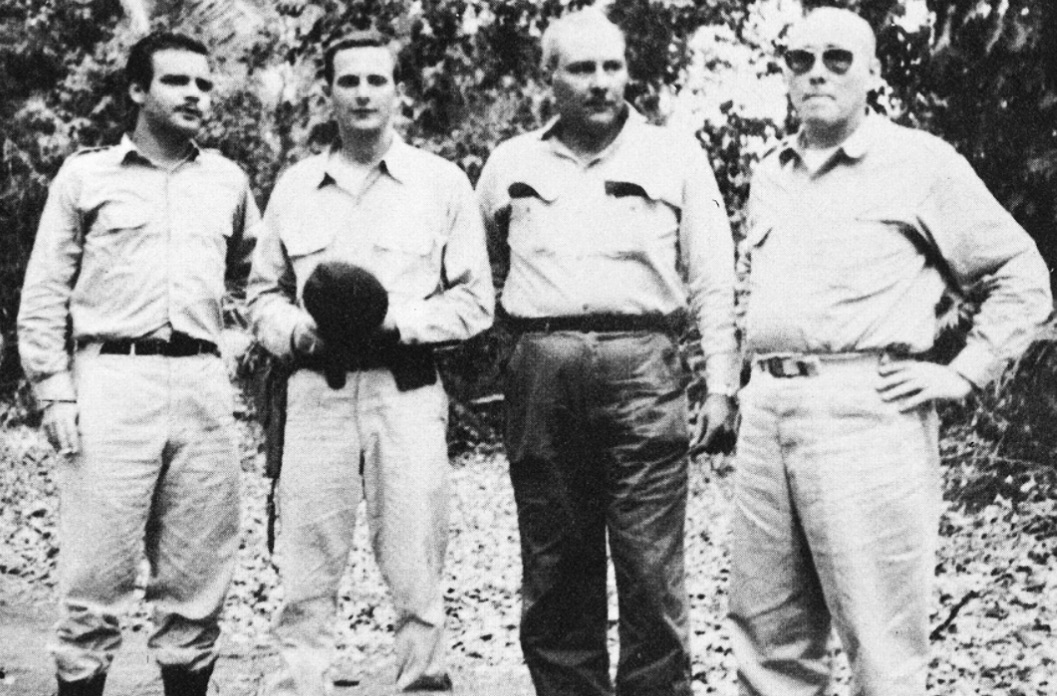
Within a month of the disastrous Bay of Pigs invasion, William Douglas Pawley found a new leadership role for himself—negotiating the release of the Brigade 2506 members and their political leader Manuel Artime (far left in photo next to the invasion ground Commander Jose Perez "Pepe" San Roman, the CRC's Antonio Maceo, and DRE founder Manuel Antonio de Varona).
1                                                                    
Pawley along with Assistant Director of Immigration and Naturalization Lou Gidel and representatives of the FRD met on May 20, 1961, at the home of Cuban Revolutionary Council (CRC) leader Dr. Jose Miro Cardona whose knowledge of Cuban law was grounded in being the former President of the Cuban Bar Association. Also in attendance was Christian Democratic Movement (MDC) leader Jose Ignacio Agusto Rasco Bermudez (cryptonym AMPALM-5) who had been president of his university’s debating society.

While the CRC was meant to unite the various Cuban exile factions, an odd wedge appeared less a year later when Dr. Miro received a letter from Madrid, Spain written to newspaperman Norman Diaz. “I am sending you these lines to acquaint you with the fascist movement which was founded in Spain and Italy and called Opus Dei which is moving in the political sphere of the political refugees in Miami.” The movement of “industrialists, merchants, professional people and elements of the extreme right” is close to Franco and “in Miami is represented by Fernandez Varela, the ‘little priest’” who is struggling “for control of the organization” with “Dr. Lasaga, who is a member of the Revolutionary Council in Miami.” The DRE “whose base is the University [of Havana] Catholic action, is involved in the fascist organization and its representatives in Miami.” Dr. Miro told his CIA contact that he “looked upon this letter as merely speculation of one person.”2

Richard Scully Cain (aka Richard Scalzetti), a former Chicago policeman turned private eye “was hired as a bodyguard for Jose Rasco during a visit to Chicago.” Months earlier, Cain had contacted the CIA’s Chicago Domestic Contact Division “Field Office and voluntarily provided information on the activities of Cuban exile groups in the Chicago area.” Following his service to Rasco, in April 1962, “Cain made an unannounced visit to Agency representative Winston Scott and Warren Dean in Mexico City” and claimed he was providing “police training to Mexican Government agents.” Two months later he was deported “for carrying a loaded revolver and brass knuckles, impersonating a Mexican Government official, and violating his tourist permit by working.”

At the May 1961 Rasco/Cardona meeting, attendees “chose spokesman on spot. Pawley will identify later.” They learned that Castro “said that feeding and housing 1214 prisoners plus 800 guards was heavy economic burden he wished to shed” in exchange for multiple ferryloads of tractors and spare parts that would last five years, a burdensome process Miro proposed to avoid Castro reneging on the agreement. “Pawley suggested to Miro this process might be streamlined and speeded by letting Canadian gov’t supervise exchange.”

After the meeting, Pawley heard the delegates comment that the brigade prisoners “are proud to have fought in the first armed battle of the free world against communism” and desire “to go back again with the experience and self-confidence they have gained from the invasion.” And despite their quick capture, Pawley reported that the “Training they received in camps and execution of amphibious landing were superb.”3

Luce’s Time magazine reported on June 2, 1961, that Castro’s ransom demand included heavy tractors. To pay for them, JFK urged former first lady Eleanor Roosevelt, United Auto Workers' President Walter Reuther and Dr. Milton Eisenhower to do fundraising. William D. Pawley contributed $25,000. On the West Coast, John (“Jake the Barber”) Factor of Los Angeles, “a Prohibition-era hoodlum who got kidnaped [sic] by other hoodlums in 1933 and knows all about ransoms sent $25,000.” But not everyone thought it was a good idea. Connecticut's Democratic Senator Thomas Dodd worried that paying ransom would create a ripple effect leading to the Communists seizing a billion. Time painted the image of Castro pleasurably “guffawing through his beard.”4

Read more »

Labels: , , , , , , , , , , , , , , ,

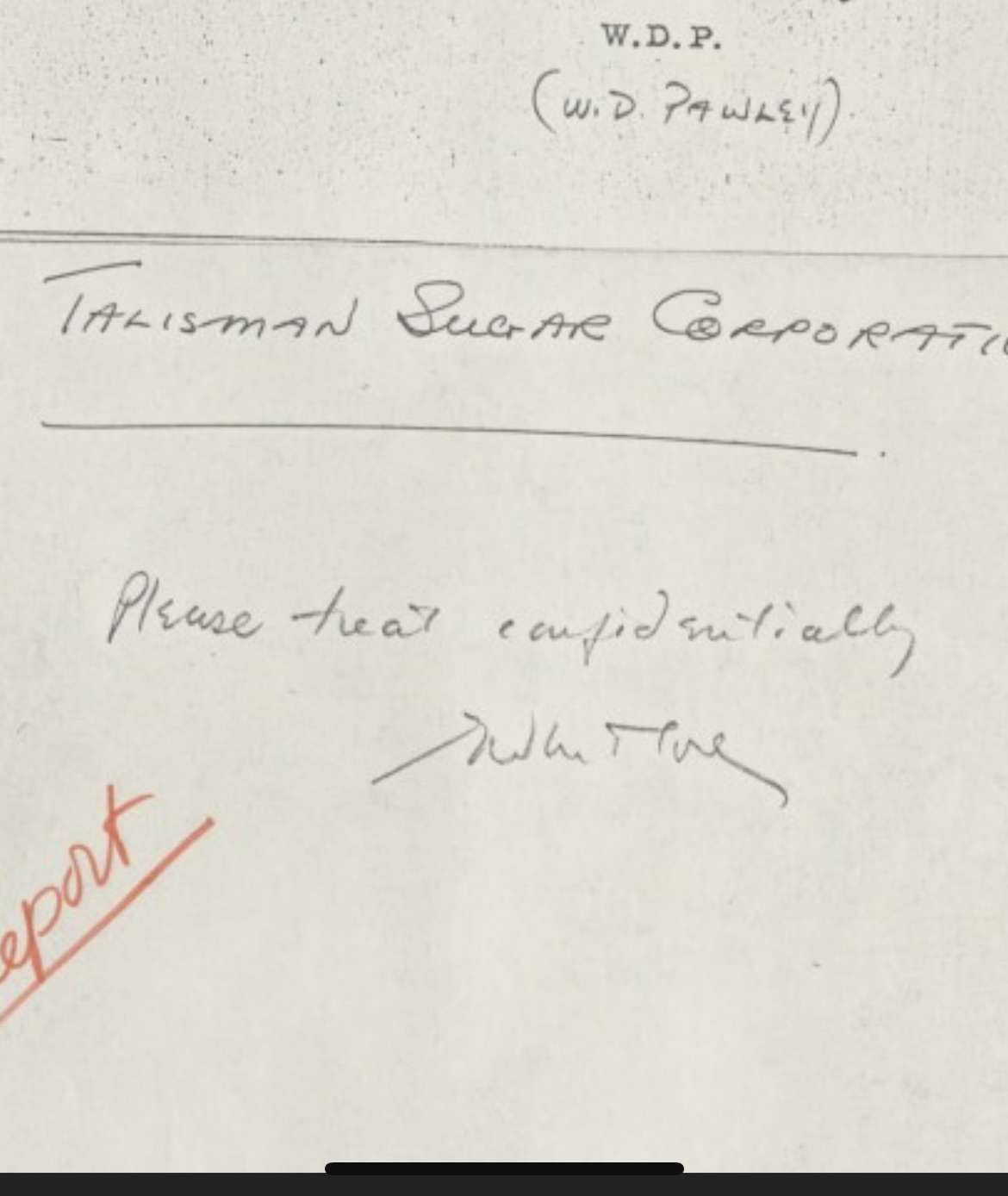
36: Back to Business: Talisman Sugar

Pawley’s re-approval for covert activity in 1964 had a focus on the Miami business community. However, CIA documents about Pawley all but disappear for years. Even a review of his activities in the next decade assumed that his involvement with the agency ceased the same year his status was renewed: “Subject appears to have remained of interest to the WH Division and the DCI until as late as 1964.”1

In that year, Pawley became president and chairman of Talisman Sugar Corp. in Belle Glade, Florida, which ranked among the largest private properties in Central Florida. As his manager of Talisman, he appointed Mike Cervera, a participant in the Bay of Pigs invasion.2 Talisman already employed a number of other opponents of Castro. The FBI looked into employees Angelito Goitia on October 16, 1961, and Octavio Ledon Baradania on December 11, 1962.3

Prior to Pawley taking control of the company, the Chief of Station of JMWAVE received a dispatch in September 1962 regarding Dr. Fernando De La Riva’s plan to organize “50 Cubans to come to Brazil [where Pawley had been Ambassador] to engage in anti-Castro activities ... De La Riva is owner or manager of the Talisman Company in Miami and also owns a part of Usina Baixa Grande sugar refining company located in Campos, Rio de Janeiro state ... De La Riva’s empire is associated with the Ford family’s financial interests.”4

The following year, FBI Special Agent Leman L. Stafford, Jr. reported on December 30, 1963, an interview with Jesus Sanchez-Martinez, an electrician at Talisman Sugar Mill, who claimed to have been invited along on a fishing trip from Miami Marine Stadium by Orlando Ramirez and Evelio Alpizar. When they got out to sea headed toward Cuba, U.S. Customs intercepted the boat and found bombs onboard.5

Read more »

Labels: , , , , , , , , , , ,