December 12, 2009

17: QDDALE

An October 2, 1959 dispatch from Miami’s CIA Western Hemisphere Division (WHD) Representative Patrick I. Karnley to the CIA’s WHD Chief J.C. King refers to William Douglas Pawley as QDDALE, the cryptonym established for him by the CIA’s Clandestine Services. Karnley reported that Pawley wished he had a tape recording of his meeting with wealthy Cuban exile Fabio Freye who seeks to topple Castro. Karnley’s dispatch also mentioned a discussion of staging an invasion against Castro from an uninhabited British island, but it was assumed the British government would balk at its usage.1

Eleven days later the CIA’s Martha Tharpe (Margarite Forsythe) recapped discussions of the use of the British island of Nassau and noted that “QDDALE is a prominent U.S. businessman in Miami with good contacts among Cuban exile groups.”2

The QD prefix appears to relate to anti-Castro activities within Cuba. In 1998, the National Archives Kennedy Assassination Collection contained 49 QDDALE documents from 1960 to 1964 in addition to 978 Pawley documents which first appear in 1950.3

Among the earliest of the dozen plus documents on QDBIAS (Pedro Diaz Lanz) is a nearly illegible one from August 1959 discussing a meeting with QDCHAR (Marcos Diaz Lanz) and QDCOVE (Ricardo de la Lorie aka Ricardo Luis de la Lorie-Bals aka Ricardo Lorie Valls) that mentions Frank Fiorini (aka Frank Sturgis) who “talks too much.”

A September 4th cable expressed CIA Headquarters “interested learning more about QDBIAS group in Cuba. Proceed as suggested taking due precautions through use of cutout to protect ODACID [U.S. State Department] from charges of abetting counterrevolutionaries.” 

A comment noted that Havana “Station officers had met with
Angel Ros ... a member of the QDBIAS group.”
5 Angel Sebastian Ros Escala was the national coordinator of the MRR and a splinter group, who would flee to Miami several months later and become AMPALM-10.6 (In the years that followed he became a double agent for Castro using the name Raul Gonzalez.)7

Read more »

Labels: , , , , , , , , , , , , , , , , , ,

18: Controlling Cuban-Exile Chaos

Publicly Vice President Richard Nixon was asserting that the U.S. should take a hands-off approach to Cuba and hope for the best.1 But in fact, Nixon had been dealing with the issue of Castro since at least April 19, 1959, when he met with Castro and then “prepared a 4-page secret memorandum and sent out copies to President Eisenhower, Secretary Herter and to Allen Dulles.” Herter was serving as Secretary of State in place of an ailing John Foster Dulles who coincidentally was hospitalized at the same time as former Secretary of State George C. Marshall. Dulles died May 24, 1959, while Marshall passed October 16, 19592 leaving a hole in William and Edna Pawley’s personal lives and William’s sphere of influence.

In the 12 months since Castro ascended to power, the Cuban government had expropriated 70,000 acres of property owned by U.S. sugar companies and United Fruit. Once again, the company would call for U.S. action to overthrow a government.

The tsunami of Cuban exiles arriving in the U.S. made that mission seem easy if someone could vet them to determine the best future political leaders and organize an effective fighting force.

On January 3, 1960, President Eisenhower announced that the U.S. was severing diplomatic relations with Cuba. On January 13th a Special Group meeting attended by CIA Director Allen Dulles and Livingston Merchant from the State Department discussed “Anti- Castro Activities.” With these actions and Eisenhower's March 17th approval of a plan to invade Cuba, he was in essence establishing an undeclared war that would hang like an albatross around Uncle Sam’s neck.

The CIA began dealing with Fidel on a formal basis on January 8, 1960, when Director Allen Dulles asked Deputy Director of Plans Richard “Dick” Bissell to organize a special task force. Ten days later the Western Hemisphere Division “organized Branch 4 (WH/4) as an expandable task force to run the proposed Cuban Operations” manned “with 18 at Headquarters, 20 at Havana Station, and 2 at Santiago Base.”

Heading WH/4 was Jacob “Jake” D. Esterline (aka Jacob Engler) who had gained “extensive guerilla warfare experience in World War II with the OSS” and was “one of the principals in Project PBSUCCESS” in Guatemala in 1954. “Esterline was the choice of J.C. King, Chief, WH Division.” As head of the WH/4 Cuban unit during the fifteen-month run up to the Bay of Pigs invasion, Esterline took his orders from the Deputy Director Plans Richard Bissell but frequently had direct contact with J.C. King and the Miami-based Cuban expert, William Pawley. Both were to be reckoned with because they “had known Republican Party affiliations.”4

King’s full role during the period and many interactions with Pawley will never be known. His papers that once filled eight safes—then only two—disappeared, according to an official history of the period.5

Read more »

Labels: , , , , , , , , , , , , , , , , , , ,

19: CIA Informant R-1

In late September 1959, the CIA’s Bernie Reichardt asked whether the Agency “had any information on Fabio Freyre, a nephew of Julio Sanchez, who is Bill Pawley’s next door neighbor.” Freyre gave Pawley “some important material” which Pawley “will forward as soon as possible.” Pawley also “told Bernie he will try to get a job for General Martin Diaz Tomayo”(one of those who had been selected for the post-Batista junta) giving Reichardt the impression that the Spanish-speaking Miamian was continuing the job-finding role he played in Panama.

When Pawley and Reichardt discussed Freyre, “Pawley suggested to Bernie that a recorder and mike for his office would be a good idea since it would permit him to make recordings of the conversations with Cubans and Dominicans who come in to discuss political matters.”2

As a result, plans were made to survey Pawley’s office to install a recording device and the “mike and wire installation was made on 15 October 1959 by employees of an Office of Security field office” according to a 1975 memo summarizing the agency’s relationship with Pawley that was finally declassified December 15, 2021.3

Read more »

Labels: , , , , , , , , , , , , , , ,

26: Days of Swine and Rose's Boys: Bay of Pigs Invasion

Fear of retaliation was a concern as the CIA planned the demise of two Western Hemisphere leaders, Castro and Trujillo. According to the CIA’s Deputy Director for Support, Col. L.K. White, on March 22, 1961, the CIA’s Sheffield Edwards and Jack Earman met with CIA Deputy Director General Charles Cabell “to point out to them that we were not furnishing the Director the personal protection which we should be furnishing in these critical times.”1

On April 4, 1961, President John F. Kennedy, the first Catholic president whose mother, Rose, prayed the rosary throughout his life, heard about the “immorality” of an invasion of Cuba voiced by Senator William Fulbright, chairman of the Senate Foreign Relations Committee. While Fulbright “denounced the proposition out of hand,” Adolphe Berle declared his belief that “a ‘power confrontation’ with Communism in the Western Hemisphere was inevitable.” Assistant Secretary of State for Inter-American Affairs Thomas C. Mann, “who previously had been on the fence, now spoke up for the operation.”2 Rose’s son’s march toward disaster proceeded headlong with the momentum created by Pawley-intelligence-exile axis.

Pawley on April 15th sat down with FBI agents Leman L. Stafford, Jr. and George E. Davis, Jr. for an interview that Pawley had requested. He let them know he was “a personal friend of the Director of the FBI, as well as of President Eisenhower, former President Truman and many other influential people in the United States and Latin America.” Pawley then voiced “that he is deeply concerned about the communist trend in Cuba and its effects on other Latin American countries, and that he has been in close contact with the U.S. State Department and the CIA relative to the situation.”3

Manuel Ray Rivero “took the view that the internal resistance was so strong that Castro could be overthrown without an ‘invasion’ from the outside.” (In truth, there was only insignificant damage from the 110 insurgent bombings between October 1960 and April 17, 1961,4 when Jose A. Perez “Pepe” San Roman led the Bay of Pigs invasion.)5

Ray’s wishy-washy stance on the need for an invasion did not sit well with Pawley, and in the weeks before the invasion Ray complained that assertions that he favored Cuba maintaining relations with the U.S.S.R. “were not true and part of a ‘campaign against him by Mr. Pawley of the Miami City Transit Company.’”6

Despite the desire to make it look like a Cuban led invasion, among the first men ashore were two non-Cubans, Grayston L. Lynch (aka Gray) and William “Rip” Robertson, who had been among those suggested as possible assassins of Castro. Lynch, a fearless veteran of the D-Day invasion at Normandy Beach, the Battle of the Bulge, and Heartbreak Ridge in Korea, would survive the debacle at the Bay of Pigs and go on to direct and participate in hundreds of more clandestine operations against Cuba. A decade before dying in 2008, Lynch published his account of the invasion imbued with anger at the failure of the Kennedy Administration to provide the essential air cover titled Decision for Disaster: Betrayal at the Bay of Pigs. Rip Robertson’s passion for adventure ended a decade later when he “died in 1973 of malaria in Laos.”7

Read more »

Labels: , , , , , , , , , , , , , , , ,

27: Brigade 2506 Hostage Negotiations

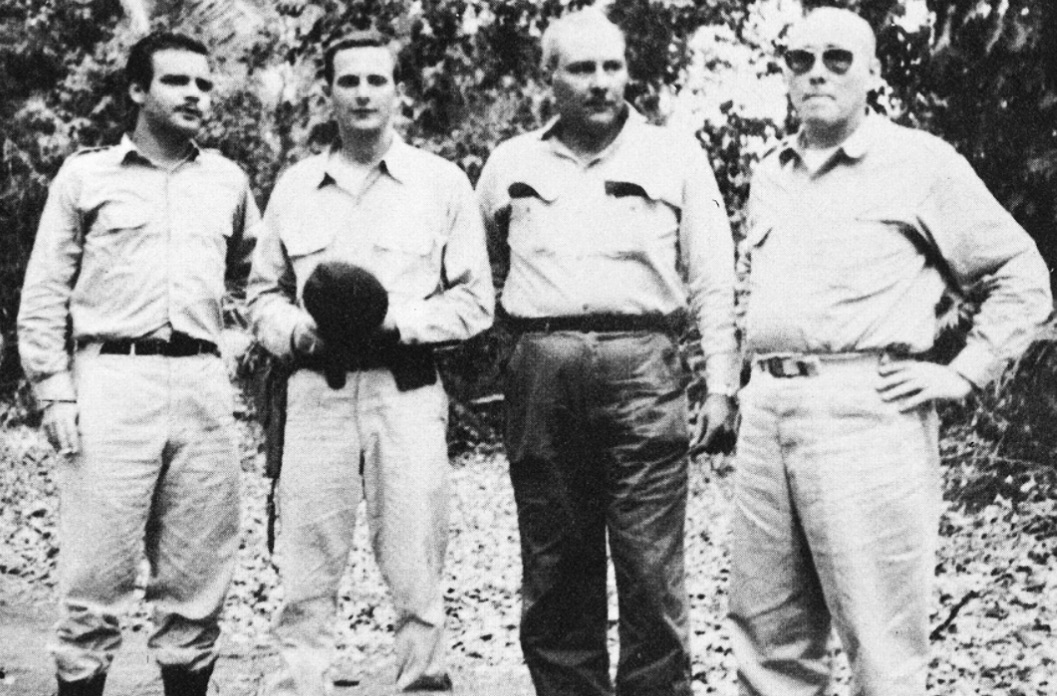
Within a month of the disastrous Bay of Pigs invasion, William Douglas Pawley found a new leadership role for himself—negotiating the release of the Brigade 2506 members and their political leader Manuel Artime (far left in photo next to the invasion ground Commander Jose Perez "Pepe" San Roman, the CRC's Antonio Maceo, and DRE founder Manuel Antonio de Varona).
                                                                   
Pawley along with Assistant Director of Immigration and Naturalization Lou Gidel and representatives of the FRD met on May 20, 1961, at the home of Cuban Revolutionary Council (CRC) leader Dr. Jose Miro Cardona whose knowledge of Cuban law was grounded in being the former President of the Cuban Bar Association. Also in attendance was Christian Democratic Movement (MDC) leader Jose Ignacio Agusto Rasco Bermudez (cryptonym AMPALM-5) who had been president of his university’s debating society.

While the CRC was meant to unite the various Cuban exile factions, an odd wedge appeared less a year later when Dr. Miro received a letter from Madrid, Spain written to newspaperman Norman Diaz. “I am sending you these lines to acquaint you with the fascist movement which was founded in Spain and Italy and called Opus Dei which is moving in the political sphere of the political refugees in Miami.” The movement of “industrialists, merchants, professional people and elements of the extreme right” is close to Franco and “in Miami is represented by Fernandez Varela, the ‘little priest’” who is struggling “for control of the organization” with “Dr. Lasaga, who is a member of the Revolutionary Council in Miami.” The DRE “whose base is the University [of Havana] Catholic action, is involved in the fascist organization and its representatives in Miami.” Dr. Miro told his CIA contact that he “looked upon this letter as merely speculation of one person.”2

Richard Scully Cain (aka Richard Scalzetti), a former Chicago policeman turned private eye “was hired as a bodyguard for Jose Rasco during a visit to Chicago.” Months earlier, Cain had contacted the CIA’s Chicago Domestic Contact Division “Field Office and voluntarily provided information on the activities of Cuban exile groups in the Chicago area.” Following his service to Rasco, in April 1962, “Cain made an unannounced visit to Agency representative Winston Scott and Warren Dean in Mexico City” and claimed he was providing “police training to Mexican Government agents.” Two months later he was deported “for carrying a loaded revolver and brass knuckles, impersonating a Mexican Government official, and violating his tourist permit by working.”

At the May 1961 Rasco/Cardona meeting, attendees “chose spokesman on spot. Pawley will identify later.” They learned that Castro “said that feeding and housing 1214 prisoners plus 800 guards was heavy economic burden he wished to shed” in exchange for multiple ferryloads of tractors and spare parts that would last five years, a burdensome process Miro proposed to avoid Castro reneging on the agreement. “Pawley suggested to Miro this process might be streamlined and speeded by letting Canadian gov’t supervise exchange.”

After the meeting, Pawley heard the delegates comment that the brigade prisoners “are proud to have fought in the first armed battle of the free world against communism” and desire “to go back again with the experience and self-confidence they have gained from the invasion.” And despite their quick capture, Pawley reported that the “Training they received in camps and execution of amphibious landing were superb.”3

Luce’s Time magazine reported on June 2, 1961, that Castro’s ransom demand included heavy tractors. To pay for them, JFK urged former first lady Eleanor Roosevelt, United Auto Workers' President Walter Reuther and Dr. Milton Eisenhower to do fundraising. William D. Pawley contributed $25,000. On the West Coast, John (“Jake the Barber”) Factor of Los Angeles, “a Prohibition-era hoodlum who got kidnaped [sic] by other hoodlums in 1933 and knows all about ransoms sent $25,000.” But not everyone thought it was a good idea. Connecticut's Democratic Senator Thomas Dodd worried that paying ransom would create a ripple effect leading to the Communists seizing a billion. Time painted the image of Castro pleasurably “guffawing through his beard.”4

Read more »

Labels: , , , , , , , , , , , , , , ,