30:Bayo, Pawley & CIA TILT Against JFK
Shortly after Groundhog Day of 1963, E. Howard Hunt wrote a memorandum about his conversation over lunch with his close friend, Manuel Artime, the Bay of Pigs invasion Brigade 2506 leader. Artime arrived “with a heavy cold and an appearance of dejection." Artime "and others (presumably San Roman and Oliva) had been guests at a luncheon tendered them the day before by the Robert Kennedys at Hickory Hill." While appreciating the Attorney General’s attention, "Artime was upset by the suggestion that Brigade members should consider "joining the U.S. Army" and "continuing their academic careers" which Artime felt "had little to do with overthrowing Fidel Castro. Artime opined that Mr. Hurwitch of State was profoundly hostile to him, for reasons he could not fathom.”1
Two months later, Hunt and Artime would meet again along with “Manolin Hernandez, his one-time deputy in the MRR,” to celebrate Dorothy Hunt’s birthday at Hunt’s home. Artime, who “was wearing the shoes that he had put into the barracks bag when he last packed it in my operational quarters in Coconut Grove” was going to deliver “a message from Luis Somoza for Attorney General Robert Kennedy” and was scheduled to appear on NBC’s Today Show. He then planned to visit Generalissimo Franco in Spain to request support in getting his parents out of Cuba and into Spain which Hunt thought would be a fruitless because Franco was too busy negotiating the renewal of U.S. air bases in Spain which Pawley had originally negotiated with the country’s fascist leader, Franco.
The discussion then turned to the “capture of 17 raiders at Norman Cay ... the exiles restricted to the Dade County area” and “Pedro Diaz Lanz whom we agreed had for some time been so uncontrollable as to raise serious doubts as to his mental stability.” Diaz Lanz, in a speech on November 3, 1963 accused President Kennedy “of being a commie.”2
Hunt then “asked about Jose Perez San Roman and learned from Artime that Pepe had suffered a mental breakdown, that the Robert Kennedys had rented a home for Pepe, his wife and two children in the McLean area and that Artime had been with them during the day when Mrs. Kennedy had come to the San Roman home and seen Artime. Artime learned that the San Roman children were driven to and from school by the Kennedys. (It turns out that the Kennedy children, my three children, and Pepe's two all attend the same parochial school on MacArthur Blvd., so it is not unlikely that Pepe's children will seek mine out as the only other Spanish-speaking children in the school.)”
Pepe’s breakdown was the result of conflicts in his marriage, the U.S. government’s pressure on him “to persuade the Brigade to enlist in the U.S. Army” and his guilt over allowing the Brigade to be captured. San Roman also resented “that his psychiatric bill was being paid by Miro Cardona, regarding it a way of making him indebted to Miro ... I judged Pepe viewed Miro as a symbol of the CRC.”
Manolin Hernandez let Howard Hunt know that Jose Miro Cardona and Jose Ignacio Rasco (MDC) had queried “as to whether I (“Eduardo”) was still in the U.S.” and that Hernandez had not revealed anything to them. By “2 o’clock in the morning,” Hunt, Artime and Hernandez “had downed a fifth of Scotch and we regrouped in the kitchen where I prepared breakfast for all. Before leaving Artime said he would call me after he had seen the Attorney General.”
During the night, Hernandez had asked Hunt about “‘Colonel Earl Brennan’ ... who was moving through the Cuban exile community looking for dark-skinned Cubans to be used in Haiti against Duvalier” which he claimed was supported by Ambassador David Bruce and the White House. A successful coup would make Haiti a great base for activity against Castro, Brennan claimed. Hunt denied knowledge of Brennan’s role in the OSS but acknowledged “that Dave Bruce had been Chief of our operations in the ETO” (European Theater of Operations in World War II).3
Col. Brennan, in fact, was recruited into the OSS by David Bruce and Allen Dulles and served as Chief/SI (Secret Intelligence) in Italy and Albania4 long before becoming “the registered representative of a Haitian political party, the Parti Nationals” which had met multiple times with the CIA to discuss a coup against “Papa Doc” Duvalier—arriving at a target date in May 1963. Individuals in multiple countries supported the move, and Trujillo’s assassination “resulted in the development of an effectively placed action center in Santo Domingo (Dominican Republic)” supported by Juan Bosch.5 Brennan’s coup fizzled out and “Papa Doc” remained in power for eight more years when heart disease and diabetes took his life.
Between William Douglas Pawley’s pro-Goldwater speech about the troubling times and John Fitzgerald Kennedy’s speech of hope for the world, Pawley embarked on his second effort to discredit JFK as the President prepared to run for a second term.
It would take more than a decade before the American public learned about the Bayo-Pawley Affair (aka Operation Red Cross). Documents declassified decades later showed that the project--as it was happening--was known within the CIA as Operation TILT.
In 1976 the Kingsport Times reported that Francis Ford Coppola's City of San Francisco magazine had published an article in which Pawley in Miami “confirmed that in 1963 he navigated his personal yacht to the Cuban coast with a raiding party bent on spiriting two Soviet missile technicians off the Communist island.” Article authors,Warren Hinckle and William Turner, had begun interviewing people about the operation in 1973, including Pawley, Gerry Patrick Hemming and Robert K. Brown whose Soldier of Fortune magazine provided more details complete with many photos of some of those involved in 1976.
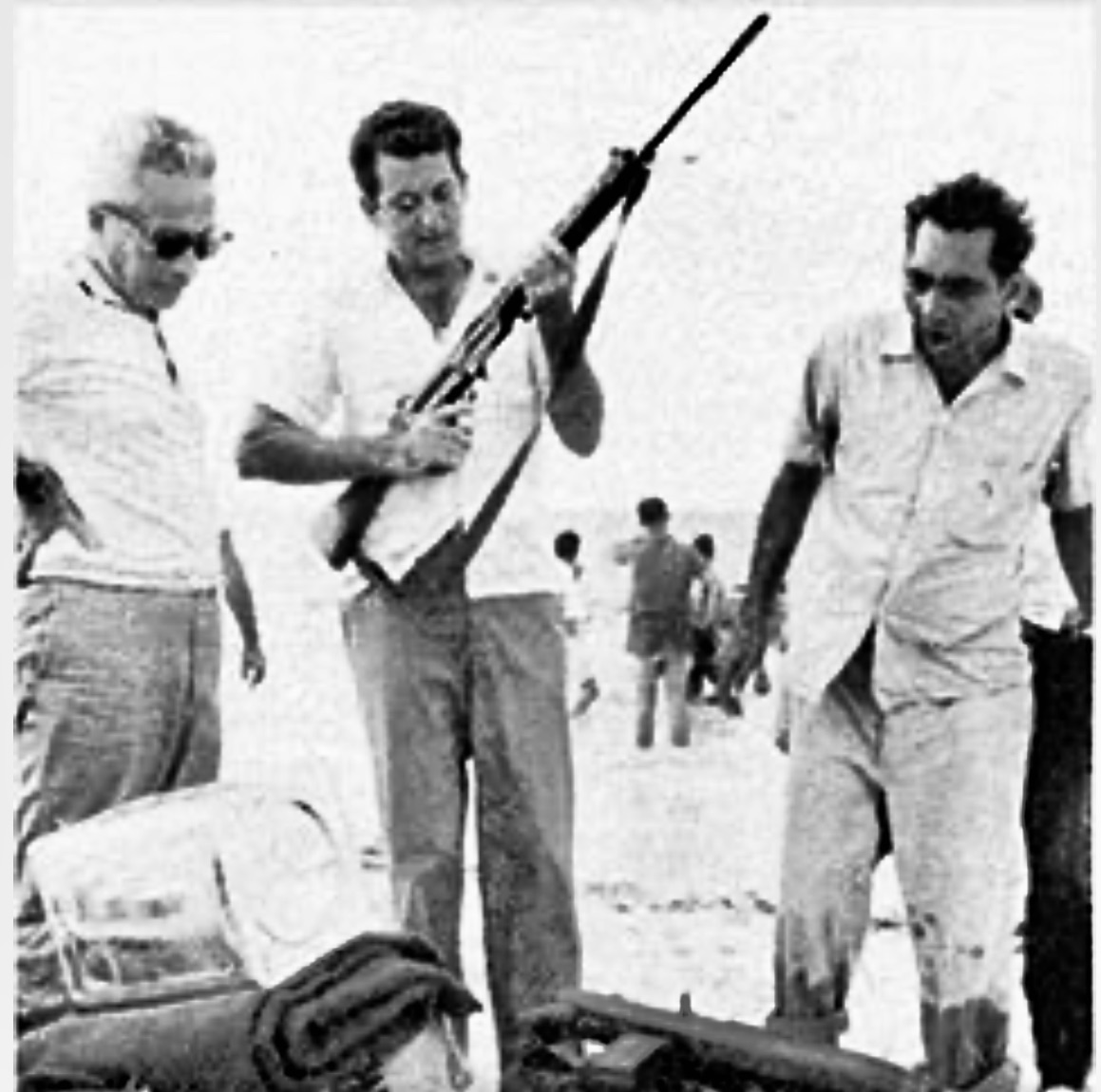
On board Pawley’s Flying Tiger II was a motley crew of CIA agents, armed Cuban exiles, an organized crime associate, John Martino (left in photo), Eddie Bayo (far right) and a Life magazine Miami reporter, Richard Billings who claimed such raids were commonplace and denied Life was financing the project as Pawley asserted. Loren Hall, after reading Hinckle's article called the author and claimed Chicago mob boss Sam Giancana put up money as well as Tampa Mafia head Santos Trafficante who had spent time in Cuban prison with John Martino. Their release was expedited by Rauol (aka Raul) Villamia, a Cuban-born minor league baseball player whose brother Mario had founded Accion Civica Cuban to support Castro by obtaining weapons along with Howard Davis as Castro was mounting his revolution against Batista. Mario convinced Rauol in 1955 to start fundraising in Tampa for Castro's 26th of July Movement which he did until Castro declared himself a communist.7
Although Pawley denied involvement of CIA agents in the actual TILT raid, members of the CIA hierarchy were not only aware of Pawley’s Flying Tiger II mission, but internal documents showed the CIA financed it along with other “angels” and tracked it from the launch through its mysterious failure—and there is no hint that they attempted to prevent him from causing an international incident or from attempting to discredit the sitting president prior to his upcoming re-election campaign.
Labels: Bayo, Billings, CIA, Clare Boothe Luce, Eastman, John Martino, Kennedy, KUBARK, Life, Mafia, Missiles, MKULTRA, Operation Red Cross, Pawley, QDDALE, Shackley, Sourwine, Soviet, TILT, William Harvey
posted by David Price Cannon @ 2:12 PM


