December 12, 2009

3: The "I" of The Flying Tigers

Recognizing that other parts of the globe could use air service, C.M. Keys turned his sights on Asia. His Curtiss-Wright Corporation partnered with the Chinese-formed China National Aviation Corporation (CNAC) to provide air travel between Hong Kong and Shanghai. This took on a significant role in the history of modern China as well as William Douglas Pawley, who saw the opportunity to sell warplanes not just in the Western Hemisphere, but to the expanding military-industrial market in the Eastern Hemisphere. By the time he was through in China, Pawley had racked up tens of millions of dollars in aircraft sales; his first commission of $250,000 in 19401 represents the equivalent of $5 million in 2024.

With solid experience in Cuban aviation under his wings, Pawley was called upon by Curtiss-Wright to determine why CNAC was losing money. Always looking for opportunities to enrich himself, he envisioned developing new routes in China as he had done in Cuba. This would create demand for more planes and more sales commissions for himself while funneling their construction to his own aircraft factory in China. He sailed to Shanghai in January 1933 to negotiate the factory proposal with the Nationalist government, but Thomas Morgan, President of Curtiss-Wright, took charge of negotiations, and the contract was signed April 1st, giving the routes to Juan Trippe’s Pan American.2

All was not lost. Despite Trippe’s success in acquiring China Airways, Pawley had made important connections that would blossom into greater wealth and fame through unanticipated world events. 

In 1935, Pawley hosted a reception honoring the Chinese Minister of Aviation, General Mao Pang-chu (aka General Mow) and members of his staff during the Miami Air Races. The Chinese group was wrapping up a global tour to learn about “air methods.” Their earlier visit to Russia, was followed by the group being guests of Adolph Hitler in Germany and Benito Mussolini in Italy, then they proceeded to France and England. Arriving in Miami, they were graciously hosted by Pawley at a reception held in the palm gardens of the recently built 18-story Roney Plaza Hotel, attended by some 300 guests.3Among the people Pawley introduced Mow to was pilot Claire Chennault, an older-looking contemporary, whom Pawley recruited to train Chinese pilots. 

Read more »

Labels: , , , , , , , , , , , , , , , , , ,

27: Brigade 2506 Hostage Negotiations

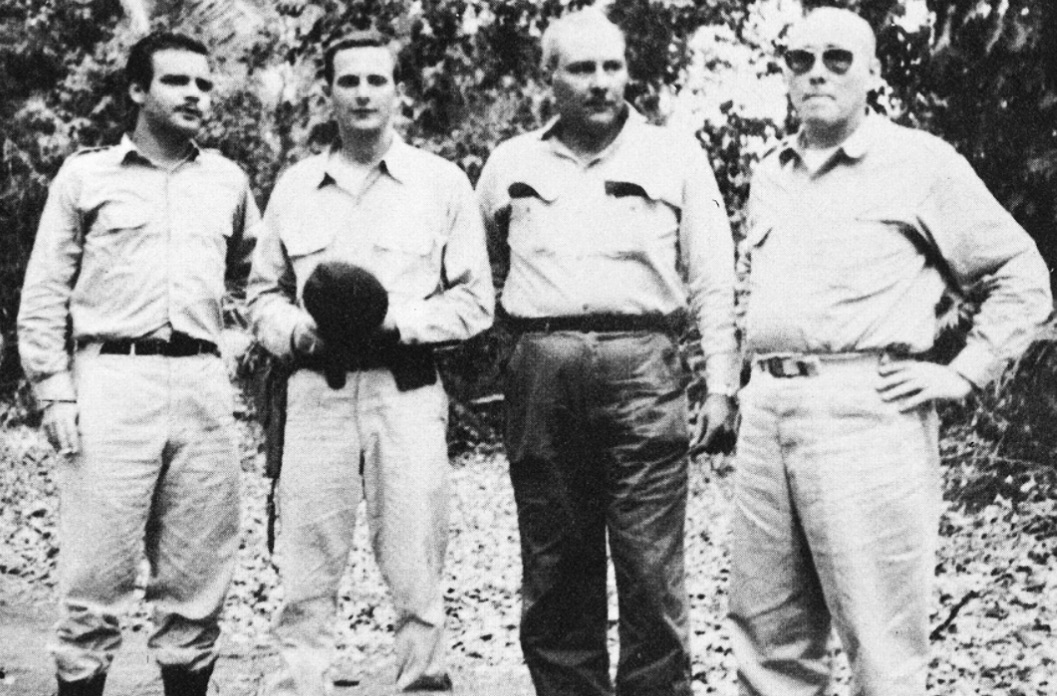
Within a month of the disastrous Bay of Pigs invasion, William Douglas Pawley found a new leadership role for himself—negotiating the release of the Brigade 2506 members and their political leader Manuel Artime (far left in photo next to the invasion ground Commander Jose Perez "Pepe" San Roman, the CRC's Antonio Maceo, and DRE founder Manuel Antonio de Varona).
                                                                   
Pawley along with Assistant Director of Immigration and Naturalization Lou Gidel and representatives of the FRD met on May 20, 1961, at the home of Cuban Revolutionary Council (CRC) leader Dr. Jose Miro Cardona whose knowledge of Cuban law was grounded in being the former President of the Cuban Bar Association. Also in attendance was Christian Democratic Movement (MDC) leader Jose Ignacio Agusto Rasco Bermudez (cryptonym AMPALM-5) who had been president of his university’s debating society.

While the CRC was meant to unite the various Cuban exile factions, an odd wedge appeared less a year later when Dr. Miro received a letter from Madrid, Spain written to newspaperman Norman Diaz. “I am sending you these lines to acquaint you with the fascist movement which was founded in Spain and Italy and called Opus Dei which is moving in the political sphere of the political refugees in Miami.” The movement of “industrialists, merchants, professional people and elements of the extreme right” is close to Franco and “in Miami is represented by Fernandez Varela, the ‘little priest’” who is struggling “for control of the organization” with “Dr. Lasaga, who is a member of the Revolutionary Council in Miami.” The DRE “whose base is the University [of Havana] Catholic action, is involved in the fascist organization and its representatives in Miami.” Dr. Miro told his CIA contact that he “looked upon this letter as merely speculation of one person.”2

Richard Scully Cain (aka Richard Scalzetti), a former Chicago policeman turned private eye “was hired as a bodyguard for Jose Rasco during a visit to Chicago.” Months earlier, Cain had contacted the CIA’s Chicago Domestic Contact Division “Field Office and voluntarily provided information on the activities of Cuban exile groups in the Chicago area.” Following his service to Rasco, in April 1962, “Cain made an unannounced visit to Agency representative Winston Scott and Warren Dean in Mexico City” and claimed he was providing “police training to Mexican Government agents.” Two months later he was deported “for carrying a loaded revolver and brass knuckles, impersonating a Mexican Government official, and violating his tourist permit by working.”

At the May 1961 Rasco/Cardona meeting, attendees “chose spokesman on spot. Pawley will identify later.” They learned that Castro “said that feeding and housing 1214 prisoners plus 800 guards was heavy economic burden he wished to shed” in exchange for multiple ferryloads of tractors and spare parts that would last five years, a burdensome process Miro proposed to avoid Castro reneging on the agreement. “Pawley suggested to Miro this process might be streamlined and speeded by letting Canadian gov’t supervise exchange.”

After the meeting, Pawley heard the delegates comment that the brigade prisoners “are proud to have fought in the first armed battle of the free world against communism” and desire “to go back again with the experience and self-confidence they have gained from the invasion.” And despite their quick capture, Pawley reported that the “Training they received in camps and execution of amphibious landing were superb.”3

Luce’s Time magazine reported on June 2, 1961, that Castro’s ransom demand included heavy tractors. To pay for them, JFK urged former first lady Eleanor Roosevelt, United Auto Workers' President Walter Reuther and Dr. Milton Eisenhower to do fundraising. William D. Pawley contributed $25,000. On the West Coast, John (“Jake the Barber”) Factor of Los Angeles, “a Prohibition-era hoodlum who got kidnaped [sic] by other hoodlums in 1933 and knows all about ransoms sent $25,000.” But not everyone thought it was a good idea. Connecticut's Democratic Senator Thomas Dodd worried that paying ransom would create a ripple effect leading to the Communists seizing a billion. Time painted the image of Castro pleasurably “guffawing through his beard.”4

Read more »

Labels: , , , , , , , , , , , , , , ,