December 12, 2009

16: Find Me Someone to Kill Castro

Pawley’s reaction to Castro taking control of Cuba was filled with thoughts of violence. Not only did it threaten his investments but embarrassed him personally by showing the folly of his buffer-government plan. He told a reporter in Miami that he would personally pay any amount to anyone who assassinated Castro. Then retracted his angry comment within days. In lieu of contracting an assassin, he began helping CIA Director Allen Dulles organize thousands of exiles fleeing Cuba to make sure the communist rebels in Cuba would be confronted by a force more ruthless than the enemy.1

On February 23, 1959, CIA Director Allen W. Dulles wrote to Pawley, thanking him for his good letter of February 18. “J.C. [King] has brought me up to date on his recent talks with you. As you know, we are running into difficulties in finding a resting place for the person about whom you telephoned me but I shall be working with State on that. I shall speak to Foster about your letter when next I see him. I know he will sincerely appreciate your thoughts. On a whole, he is making as good progress as could be expected and well tolerating the treatment he is receiving.”

In April 1959 Castro visited the United States for eleven days, giving the most optimistic Americans hope that he would not become a total surrogate for the Soviet Union.2 But when Castro returned to Cuba, he put a limit on private land holdings with the state expropriating the remainder under a policy of Agrarian Land Reform. That summer, President Urrutia resigned, and Osvaldo Dorticos Torrado became the country's president.3

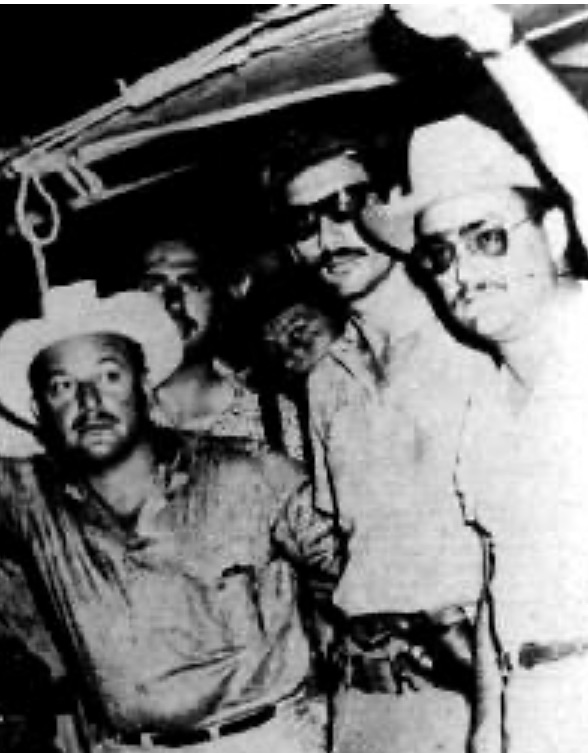
On July 27, 1959, Marcos Diaz Lanz (MDL), who was on Raul Castro’s list of government officers to be purged, escaped from Cuba to Florida with the assistance of Bernard Barker (right in photo) who earlier had transferred Marcos to a CIA safehouse in Cuba. Three weeks later, Marcos was “living in Fiorini’s house” in Florida while Barker remained in Cuba for another six months. After finally arriving in Miami, Barker and Frank Fiorini (aka Frank Sturgis; left in photo) would take part in numerous attempts to overthrow the Castro brothers. (A dozen years later, Sturgis and Barker would be arrested with E. Howard Hunt, Virgilio Gonzalez, James McCord, Jr., and Eugenio Rolando Martinez after a break-in at the Democratic National Headquarters in the Watergate Hotel in Washington, DC.)4

Read more »

Labels: , , , , , , , , , , , , , , , , ,

17: QDDALE

An October 2, 1959 dispatch from Miami’s CIA Western Hemisphere Division (WHD) Representative Patrick I. Karnley to the CIA’s WHD Chief J.C. King refers to William Douglas Pawley as QDDALE, the cryptonym established for him by the CIA’s Clandestine Services. Karnley reported that Pawley wished he had a tape recording of his meeting with wealthy Cuban exile Fabio Freye who seeks to topple Castro. Karnley’s dispatch also mentioned a discussion of staging an invasion against Castro from an uninhabited British island, but it was assumed the British government would balk at its usage.1

Eleven days later the CIA’s Martha Tharpe (Margarite Forsythe) recapped discussions of the use of the British island of Nassau and noted that “QDDALE is a prominent U.S. businessman in Miami with good contacts among Cuban exile groups.”2

The QD prefix appears to relate to anti-Castro activities within Cuba. In 1998, the National Archives Kennedy Assassination Collection contained 49 QDDALE documents from 1960 to 1964 in addition to 978 Pawley documents which first appear in 1950.3

Among the earliest of the dozen plus documents on QDBIAS (Pedro Diaz Lanz) is a nearly illegible one from August 1959 discussing a meeting with QDCHAR (Marcos Diaz Lanz) and QDCOVE (Ricardo de la Lorie aka Ricardo Luis de la Lorie-Bals aka Ricardo Lorie Valls) that mentions Frank Fiorini (aka Frank Sturgis) who “talks too much.”4 

A September 4th cable expressed CIA Headquarters “interested learning more about QDBIAS group in Cuba. Proceed as suggested taking due precautions through use of cutout to protect ODACID [U.S. State Department] from charges of abetting counterrevolutionaries.” 

A comment noted that Havana “Station officers had met with
Angel Ros ... a member of the QDBIAS group.”
5 Angel Sebastian Ros Escala was the national coordinator of the MRR and a splinter group, who would flee to Miami several months later and become AMPALM-10.6 (In the years that followed he became a double agent for Castro using the name Raul Gonzalez.)7

Read more »

Labels: , , , , , , , , , , , , , , , , , ,

31: JFK Disapproves the Somoza Plan Backed by Pawley

After Operation TILT, William Pawley turned his attention to General Luis Somoza's plan to invade Cuba from Nicaragua with hopes it would justify full U.S. intervention, while John Martino shifted his energy to a new project involving Rolando Masferrer Rojas and an invasion of Haiti in August 1963. The common goal was to eliminate Castro.

A CIA telegram stated, “According to Carlos Zayas Castro, a colleague of Rolando Arcadio Masferrer Rojas, and several other unidentified persons in the Miami area, the recent Haitian activities were organized and supported by Masferrer, a Cuban exile who travels between New York and Miami. (Field comment: General Leon Cantave is generally credited with having organized the 5 August invasion of Haiti. Masferrer may have been seeking personal aggrandizement had the invasion been successful.)”

The telegram further noted that Masferrer “had Cubans in place in the Dominican Republic and in Haiti; he attempted to recruit 30 men from the Commandos L Group through Zayas.” Masferrer planned “to establish Carlos Marquez Sterling, a leading Cuban exile, as the figurehead or President.” Without addressing the source of his money, the telegram stated that “John Martino financed the travel of about 200 Cubans from New York to Miami” who as of August 8th were staying “in the Senate Hotel [probably the Art Deco Senator Hotel on Collins Avenue at 12th Street] and another hotel in Miami. Martino did not know what to do with his men following the collapse of the Haitian invasion.”1

Rolando’s brother, Raimundo Masferrer, who moved to Dallas in 1958 where he worked for the Parks Department as a mechanic, helped raise money for arms, believing the invasion would pave the way to overthrowing Castro who had imprisoned six of their family members and whose forces shot six others in 1959.2

In January 1960, William Pawley had advised the CIA that he had been contacted by Arthur Patton, a Commissioner from Dade County, Miami, Florida, who asserted that one of his police officers had been offered $200,000 to kidnap another of Rolando’s brothers, Rodolfo “Kiki” Masferrer.3

Rolando Masferrer had come to the attention of the intelligence agencies as early as 1948.4 He tried to endear himself to Trujillo in 1956.5 After arriving in the U.S., Rolando lead exile raids against Castro.6 Prior to the Bay of Pigs, the CIA tried to neutralize his activities against Castro7 and the Kennedy Justice Department later indicted Masferrer for plotting an invasion against Cuba.8 He then turned his attention to trying to overthrow Duvalier in Haiti, in the summer of 1963.9

Read more »

Labels: , , , , , , , , , , , , , , , ,

35: Our only hope, Goldwater

On March 6, 1964, a splintering of Pawley’s clout in the Florida Republican Party was revealed. Pawley’s favored candidate, conservative Barry Goldwater--whom Pawley believed was "our only hope" for the nation-- “expressed himself as not being ‘overly concerned’ with the Florida intra-party struggle. Nevertheless, there is bad blood in Florida Republican ranks, and it could hurt Barry,” reported the Muscatine Journal.

Clifton White and Richard Kleindienst were sent by Goldwater to Tampa to smooth things over. “When Barry Goldwater landed in Palm Beach, he was handed a memo from, a close adherent of Basil LaVergne, head of the Draft Goldwater movement in Florida. The memo was a petition for Barry Goldwater to step in and appoint somebody with the authority to force both Brown and Cramer into line. William D. Pawley, “one of the most respected Florida Republicans” was mentioned as one possibility: Victor Hruska, vice president of the Prudential Insurance Company of Jacksonville, was another.

It was a sticky situation for Goldwater because Pawley and Hruska had already been approved by Brown, “and Goldwater could hardly undercut Grenier, his southern regional director, without causing bad blood in Alabama and Mississippi.”

The Florida conservatives believed that LBJ would lose because “Lyndon Johnson hurt himself on his appearance in Florida last week when he skipped over the dubious constitutionality of some features of the civil rights bill.”1

On March 25, 1964, the FBI reported on its interrogation of Dr. Fernando Penabaz Coburn, a Duke graduate who became a Cuban lawyer before fleeing to Miami in 1960 and becoming a newspaper writer and anti-Castro propagandist at JMWAVE. Like others in Miami’s anti-Castro milieu, Penabaz claimed Oswald had connections to Castro. 

While attending “the Third Annual National Anti-Communist Leadership School, sponsored by the Christian Crusade,” Penabaz met with its founder, evangelical Reverend Billie James Hargis who spread his message on hundreds of radio and TV stations across America. “Dr. Penabaz stated that during the period of his visit at Shreveport, [February 1964] he recalled having a visit in the room of the Reverend Hargis, at which General Edwin Walker was present.” Regarding the topic of the JFK assassination, “Dr. Penabaz stated he probably did say that one could argue in favor of the thesis that Castro may have had reasons to eliminate President Kennedy,” because “President Kennedy wanted him deposed as the leader in Cuba.” In fact, in September 1963, “Castro virtually threatened President Kennedy by a statement to the effect that leaders threatening him (Castro) better be careful, because they, too, could suffer accidents.” Penabaz even claimed there was a cartoon in a Cuban newspaper showing Castro laughing over a dead Kennedy shortly before the assassination—but the FBI found no copy of it.

Penabaz told his FBI interrogator he was unaware of the article in William F. Buckley’s National Review that asserted a reporter at The New York Times “had obtained from a very good source the story of Oswald’s trip to Mexico and subsequent return to the United States with the sum of $10,000, but that the Times “mysteriously withheld the story.” Months earlier, Clare Boothe Luce had used her good friend Buckley’s National Review to denounce Kennedy.2

“With respect to information that Oswald, on return from his alleged trip to Cuba, was accompanied by Quintin Pino [Machado], who was to take Oswald to Cuba after the assassination, Dr. Penabaz stated he had not made such a statement to anyone as being fact. He stated that he had heard [from Miguel de Leon] of an alleged plot wherein Quintin Pino had crossed into Texas from Mexico for the purpose of rescuing Oswald.” Miguel “de Leon stated he had learned this while visiting the home of Cuban engineer Sixto Mesa about a week after the assassination” but could not recall who said it. Mesa “stated it was Dr. [Adolfo] Vilasuso who had related the story.” Yet, Dr. Vilasuso stated he possessed no authentic information.

Dr. Penabaz denied to the FBI that he claimed “Oswald had been shot by Jack Ruby for failing to follow the escape plan after the assassination” but “may have said that such a possibility existed.”3 During a television interview on December 5, 1963, Penabaz had also claimed Jack Ruby was a communist.4 Coincidentally, Penabaz knew the DRE’s Carlos Bringuier whose interactions with Oswald on the streets of New Orleans helped paint him as a communist.5

Read more »

Labels: , , , , , , , , , , , ,