August 7, 2023

1: Love, “Cuba”

Few men reflect the times in which they live as vividly as William Douglas Pawley. Born in Florence, South Carolina, on September 7, 1896, he matured in a period when America was rapidly turning the corner from an agricultural economy to an industrial society. As amazing advances in technology were transforming the nation into a world power, this son of Edward Porcher Pawley and Mary Irene Wallace Pawley quickly recognized that fortunes were waiting to be made all around him—and all around the world— if he pursued them without fear of failure.

The Pawley family had roots in South Carolina dating to colonial times1 when Percival Pawley, Sr. in 1711 was granted the land in proximity to what is now Pawleys Island, an isle known in the 21st century for being an “arrogantly shabby” residential community where low-country cooking and beer mix freely with a refreshing breeze off the Atlantic Ocean. Earlier, in the 1700s, rice plantation owners such as Thomas George Pawley vacationed on Pawleys Island to escape the threat of malaria from May through October, because the isle was surrounded by saltwater marshes that were inhospitable to mosquito breeding.2 Even though Hurricane Ian made landfall less than 10 miles away in 2022 with a seven-foot surge that destroyed the pier, islanders quickly cleaned up the sand, mud and debris attesting to Pawleys Island’s resiliency over the centuries as a desirable southern beach destination.3 

Edward Porcher Pawley was born during the Civil War a few counties away from where the Confederate rebellion had exploded at Ft. Sumter. As a young man, he tried to make his fortune in cotton, but plantations suffered after their cheap slave labor was freed, and he soon faced bankruptcy. Fortunately, Edward had learned a merchant’s trade, selling dry goods in Florence, and was able to pursue other opportunities beyond South Carolina.4

The inflammatory sinking of the USS Maine triggered the Spanish-American War and the U.S. invasion of Cuba made famous by the American Rough Riders charging up San Juan Hill. It not only catapulted the cavalry’s victorious leader, Colonel Teddy Roosevelt, to governor of New York State but made Cuba a fertile ground for William Pawley’s father’s ambitions. By 1900, Edward Porcher Pawley moved his wife, Mary, and their sons, George Plummer Pawley and William Douglas Pawley to eastern Cuba where he established E.P. Pawley Co. of Caimanera. About 1908, at some 64 years of age, he opened a branch store nearby at South Toro Cay, close to the wharf that supplied the United States Naval Station at Guantánamo Bay.

Read more »

Labels: , , , , , , , , , , , , , , , ,

December 12, 2009

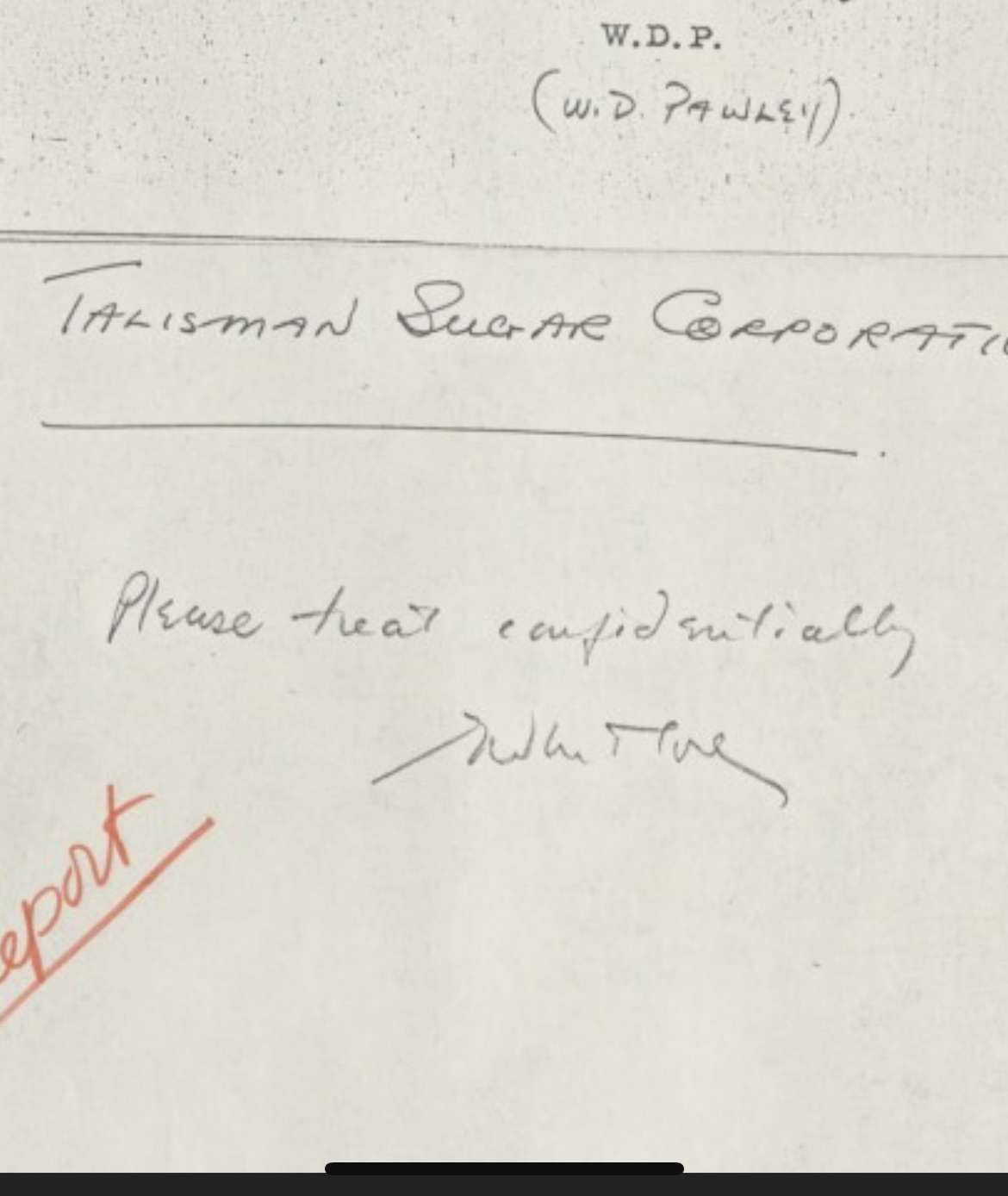
36: Back to Business: Talisman Sugar

Pawley’s re-approval for covert activity in 1964 had a focus on the Miami business community. However, CIA documents about Pawley all but disappear for years. Even a review of his activities in the next decade assumed that his involvement with the agency ceased the same year his status was renewed: “Subject appears to have remained of interest to the WH Division and the DCI until as late as 1964.”1

In that year, Pawley became president and chairman of Talisman Sugar Corp. in Belle Glade, Florida, which ranked among the largest private properties in Central Florida. As his manager of Talisman, he appointed Mike Cervera, a participant in the Bay of Pigs invasion.2 Talisman already employed a number of other opponents of Castro. The FBI looked into employees Angelito Goitia on October 16, 1961, and Octavio Ledon Baradania on December 11, 1962.3

Prior to Pawley taking control of the company, the Chief of Station of JMWAVE received a dispatch in September 1962 regarding Dr. Fernando De La Riva’s plan to organize “50 Cubans to come to Brazil [where Pawley had been Ambassador] to engage in anti-Castro activities ... De La Riva is owner or manager of the Talisman Company in Miami and also owns a part of Usina Baixa Grande sugar refining company located in Campos, Rio de Janeiro state ... De La Riva’s empire is associated with the Ford family’s financial interests.”4

The following year, FBI Special Agent Leman L. Stafford, Jr. reported on December 30, 1963, an interview with Jesus Sanchez-Martinez, an electrician at Talisman Sugar Mill, who claimed to have been invited along on a fishing trip from Miami Marine Stadium by Orlando Ramirez and Evelio Alpizar. When they got out to sea headed toward Cuba, U.S. Customs intercepted the boat and found bombs onboard.5

Read more »

Labels: , , , , , , , , , , ,