31: JFK Disapproves the Somoza Plan Backed by Pawley
After Operation TILT, William Pawley turned his attention to General Luis Somoza's plan to invade Cuba from Nicaragua with hopes it would justify full U.S. intervention, while John Martino shifted his energy to a new project involving Rolando Masferrer Rojas and an invasion of Haiti in August 1963. The common goal was to eliminate Castro.
A CIA telegram stated, “According to Carlos Zayas Castro, a colleague of Rolando Arcadio Masferrer Rojas, and several other unidentified persons in the Miami area, the recent Haitian activities were organized and supported by Masferrer, a Cuban exile who travels between New York and Miami. (Field comment: General Leon Cantave is generally credited with having organized the 5 August invasion of Haiti. Masferrer may have been seeking personal aggrandizement had the invasion been successful.)”
The telegram further noted that Masferrer “had Cubans in place in the Dominican Republic and in Haiti; he attempted to recruit 30 men from the Commandos L Group through Zayas.” Masferrer planned “to establish Carlos Marquez Sterling, a leading Cuban exile, as the figurehead or President.” Without addressing the source of his money, the telegram stated that “John Martino financed the travel of about 200 Cubans from New York to Miami” who as of August 8th were staying “in the Senate Hotel [probably the Art Deco Senator Hotel on Collins Avenue at 12th Street] and another hotel in Miami. Martino did not know what to do with his men following the collapse of the Haitian invasion.”1
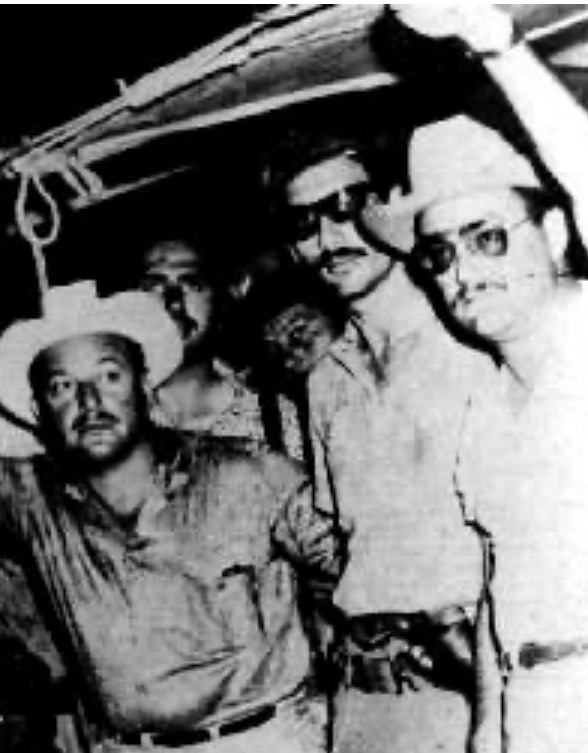
In January 1960, William Pawley had advised the CIA that he had been contacted by Arthur Patton, a Commissioner from Dade County, Miami, Florida, who asserted that one of his police officers had been offered $200,000 to kidnap another of Rolando’s brothers, Rodolfo “Kiki” Masferrer.3
Rolando Masferrer had come to the attention of the intelligence agencies as early as 1948.4 He tried to endear himself to Trujillo in 1956.5 After arriving in the U.S., Rolando lead exile raids against Castro.6 Prior to the Bay of Pigs, the CIA tried to neutralize his activities against Castro7 and the Kennedy Justice Department later indicted Masferrer for plotting an invasion against Cuba.8 He then turned his attention to trying to overthrow Duvalier in Haiti, in the summer of 1963.9
Labels: Artime, Carter, CIA, David Philips, Desmond Fitzgerald, Fiorini, Fonzi, Kennedy, Marquez Sterling, Martino, Masferrer, Morales, Pawley, Pedro Diaz Lanz, Somoza, Sturgis, Veciana
posted by David Price Cannon @ 2:10 PM


