December 12, 2009

21: Dictating to Dictator Trujillo

Pawley’s entrepreneurship and bilingual skills led to global success and wealth that gave him easy access not only to U.S. presidents but also to Generalissimo Trujillo, the dictator of the Dominican Republic, who profited so much from the Pawley family’s thriving businesses that William believed he could dictate the course of the country. In 1955, Trujillo asked Pawley to help him write laws to attract U.S. investment in oil and minerals. That same year, Vice President Nixon was criticized for embracing the dictator.

On January 20, 1960, Jane Atherton Roman, who served as liaison between the CIA and FBI as a senior aide to CIA counterintelligence head, James Jesus Angleton, received a document that listed Edward Pawley as the subject. One who read it wondered if it was actually about his brother, William. The document noted that following trips to Florida and Cuba, “Catherine Taaffe, whose activities are well known to the intelligence community” advised that “there was a widespread belief among Cubans that the United States Government, and specifically CIA, was sponsoring anti-Castro plotting” and, according to former Havana lawyer Francisco Rodriguez Couceiro, Edward Pawley was working with the CIA on the effort. The document had a handwritten note: “Probably Wm D. Pawley Miami.” Mrs. Roman wrote beneath it: “Or his brother, Edward, who represents the Pawley business interest in the Dom. Rep.”

An English major graduate from Smith College, Jane Atherton worked in advertising then served in the OSS in 1944. A decade later, she married CIA co-worker Howard Edgar Roman who became a researcher for two books written by CIA Director Allen Dulles. Ten weeks before reading about the Pawleys activities, Jane Roman had opened the CIA's first file on Lee Harvey Oswald, a U.S. Marine Corps radar operator who, after learning Russian and monitoring U-2 flights over Russia, defected to Russia. By the summer of 1963, William Pawley and Lee Harvey Oswald would both interact with the CIA-funded Cuban-exile group DRE.         

In February 1960 an article appeared in the Miami Herald, titled “Smathers at Conference: Miamian Pawley Had a Part in Trujillo’s ‘Free Vote’ Vow.” While it mentions that Edward Pawley lives in Cuidad Trujillo and manages the Pawley mining and oil interests, the article notes that William Pawley is a longtime friend and an informal “economic advisor” to the Dominican Republic Dictator Rafael Trujillo, who accepted his advice and promised “to hold free multiparty elections within a year.”1

At the Dominican Republic press conference, Senator George Smathers was joined by William Pawley who stated that he had recently sold all of his investments in the country, while assuring the media that Trujillo was not in trouble, even though he recently had broken up a plot to overthrow his regime. Pawley “told The Herald from Washington his motives were ‘patriotic—to keep another Communist regime from forming in the Caribbean.’” He claimed that Smathers and Trujillo “each recognized that the Caribbean is entering a new period. A revision of regimes unacceptable to democratic nations has to be made,’ Pawley added.”2

Read more »

Labels: , , , , , , , , , ,

33: Shockwaves

The Kennedy assassination shook the nation, but one of JFK’s friends took it harder than others. When Edward Grant Stockdale’s Irish eyes stopped smiling there may have been more to his depression than was ever revealed.

Stockdale was the former U.S. Ambassador to Ireland. On November 26th, he flew to Washington and talked with Robert Kennedy and Edward Kennedy. Upon his return to Miami, Stockdale told several of his friends that “the world was closing in.” On December 1st, he spoke to his attorney, William Frates, who later recalled their conversation. “He started talking. It didn't make much sense. He said something about ‘those guys’ trying to get him. Then about the assassination.” William Snow Frates and his partners, Peter Thorp Fay and Robert Lester Floyd, coincidentally were the subjects of a December 6th memo seeking CIA covert security approval for the three attorneys “who will be used as officers in KUVEST” which appeared to be a funding mechanism “through notional companies for JMWAVE payroll companies.”1

On December 2, 1963, Grant Stockdale fell to his death from his office window on the thirteenth floor of the exquisite art deco Alfred I. duPont Building, Miami’s first commercial skyscraper at 169 East Flagler Street.2 The building lobby housed a major branch of Florida National Bank & Trust Co. headquartered in Jacksonville which Alfred duPont had purchased in 1929 and named his wife Jessie Ball duPont to the Board of Directors. Upon Alfred’s death in 1935, Jessie’s brother, Ed Ball, took charge of bank through his leadership of the Alfred I. duPont Testamentary Trust.

The Alfred I. duPont Building from which Stockdale plunged should not be confused with the DuPont Plaza Center building at 300 Biscayne Boulevard Way (U.S. 1), Miami, where Life magazine was located on the eighth floor. That building sat at a sharp turn in the road— similar to the Dealey Plaza presidential motorcade route—just before it turns past Bay Front Park where 15,000 family members and friends had gathered waiting for the return of the Cuban exiles involved in the Bay of Pigs invasion.3 Three decades earlier, five shots rang out in Bay Front Park shortly after President-elect Franklin Delano Roosevelt delivered a short speech. The disgruntled, lone-nut, would-be assassin Giuseppe Zangara missed Roosevelt, but five people were struck by bullets and Chicago Mayor Cermak would die later from complications. Zangara died in the electric chair just 14 days after Cermak died.

A rightwing plot—lead by Joseph Milteer of the National States Rights Party—to assassinate President Kennedy with a rifle from an office building in Miami on November 18th was publicly revealed in 1967 as I drove along S.W. 8th Street in Miami after eating breakfast at The Skillet. In 1963, the threat was taken seriously enough by the Secret Service that President Kennedy's motorcade was canceled and instead he and  Senator George Smathers were driven to a helicopter that flew them to Miami Beach where he delivered a speech to the Inter-American Press Association signaling a desire for peace in the Caribbean which was not what Pawley and Cuban exiles wanted to hear.5


JFK and Senator George Smathers at Miami International Airport 11/18/1963 awaiting a helicopter ride after cancelling a motorcade out of security concerns four days before Kennedy was assassinated 1,300 miles away in Dallas. (Photo: Joe Rimkus/State Archives of Florida)


According to FBI reports printed in Don Adams's From an Office Building with A High-Powered Rifle: A Report to the Public from an FBI Agent Involved in the Official JFK Assassination Investigation, the 62-year-old Joseph Adams Milteer from Quitman, Georgia who sometimes lived with a prostitute in Valdosta, Georgia believed John Kennedy, Nikita Kruschev, Martin Luther King and Jewish people were undermining America. (His patriotic zealotry didn't extend to what he drove: a 1962 Volvo and her Volkswagen.)  Milteer had inherited $200,000 from his father and spent it printing pamphlets spreading his segregationist point of view as a member of the White Citizens Council of Atlanta. He supported Strom Thurman for President in 1962 and attended a rally in Fort Lauderdale for Barry Goldwater shortly after revealing his belief that President Kennedy would be shot in Miami from building with a high-powered rifle. Coincidently, the Miami-Fort Lauderdale-Palm Beach Goldwater delegate and the honorary chairman of the Florida Republican Party campaign for Goldwater was William Douglas Pawley. FBI Special Agent Don Adams included in his book a reprint of a photo he had seen in the Harrison Edward Livingstone and Robert J. Groden book High Treason: The Assassination of JFK and the Case for Conspiracy which possibly shows Milteer at Dealey Plaza on November 22, 1963. The picture is odd because Milteer is in a short sleeve shirt while others wear coats and he is taller than many others despite his FBI reported height of 5'4". 

A December 2, 1963 Miami News report stated that Ambassador Grant Stockdale had looked at a Life magazine covering the Kennedy assassination."After smoking a cigarette, he lept out a window, "hitting a ledge eight floors below.” He was to have hosted Senator Ted Kennedy’s visit to Miami on the occasion of the University of Miami’s homecoming ceremony on December 14th. Stockdale was the chairman of the homecoming event, which was cancelled when he died.7 (In 1969, I received my AB degree in American Civilization from the University of Miami.)

Stockdale did not leave a suicide note but Miami Homicide Detective Robert Utes said Pawley’s friend, Senator George Smathers, who had an office in the same building, claimed that Stockdale had become depressed as a result of the death of John F. Kennedy. Stockdale had been Smathers’ administrative assistant in 1946. As word was being spread by the DRE that Oswald was associated with the Fair Play for Cuba Committee, no doubt Smathers recalled that his proposal to cut to U.S. sugar imports from Cuba by 10% was ridiculed in the FPCC's May 13, 1960 Fair Play newsletter under the headline "Sweetening the Bitter Tea of Senator Smathers."     

Read more »

Labels: , , , , , , , , , , , , , , , , , , ,

38: Anna Chennault's Halloween Surprise

As male baby boomers, like myself, graduated high school in record numbers and faced the possibility of being drafted and sent to Southeast Asia, Americans focused more on the escalating war in Viet Nam than the threat in the Caribbean. And Pawley’s dire warnings about Cuba got less and less ink.

It was a turbulent time in America. On April 4, 1968, civil rights leader, Martin Luther King, was assassinated by another “lone gunman,” James Earl Ray. Riots broke out across America. White flight from the inner cities separated the human race even more. Two months after delivering an eloquent speech calling for calm and reconciliation in the wake of Dr. King’s murder, Presidential candidate, Robert F. Kennedy, was assassinated by yet another loner, Sirhan Sirhan.1

In July, Pawley was honored for his glory days in China. “Bill Pawley received the first CNAC Award for contribution to aviation in China” at a reunion of the CNAC and Flying Tiger “‘Old China Hands.’” He gave a rousing banquet speech to the attendees including Edna Pawley, his brothers, Gene and Ed, and their wives.” Eugene Pawley first went to China in 1939, returned in June 1942 to drive CNAC supplies, then switched over to intelligence, heading the OSS China Desk. Ed helped organize the Flying Tigers, while Bill built planes. The celebrity attraction at the CNAC event was 1950s heavyweight champion boxer Rocky Marciano, who ironically died the following year in an airplane crash. One of the other CNAC Award highlights was a party hosted by Edna and William Pawley at their Miami home during which they gave the attendees a cruise on Biscayne Bay aboard his Flying Tiger yacht.

Anna Chennault, widow of the Flying Tiger leader General Claire Chennault, sent a letter of regret that she could not attend the July 22, 1968 event “due to urgent business matter I have to leave for the Far East and Southeast Asia.”

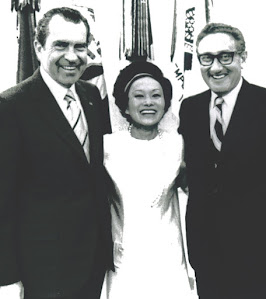
Anna had served as an advisor to Nixon and Secretary of State Henry Kissinger on the region. She had developed close relationships with the top tier of the South Vietnam leadership. When President Johnson halted U.S. bombing of the communist North Vietnam, Anna, two days after Halloween, conveyed to a representative of the South Vietnamese government that it should stall the Paris Peace Talks until after Nixon was elected President, promising a better outcome. Anna received Nixon’s instruction from a longtime friend of Pawley and Anna—Chiang Kai-Shek—according to author George J. Veith in 2022.3

Read more »

Labels: , , , , , , , , , , , , , ,

39: The Détente Betrayal

William Douglas Pawley’s support of Richard Nixon in 1968 was based upon a longstanding relationship that began while Nixon was Vice President to Eisenhower, and it was reinforced by a mutual disdain for communists shared by all conservatives including E. Howard Hunt. But the times they were a changing as much as Bob Dylan switching from folk to country rock with his release in April 1969 of Nashville Skyline.

Once sworn in, President Nixon began to head down a different path from ruthlessly battling communism toward embracing détente. In February 1970, Henry Kissinger began secret talks with North Vietnamese negotiator Le Duc Tho outside Paris, while the more public, formal peace process ground slowly away in the city. Pawley, like most Americans, was out of the loop on Nixon’s new strategy. 

Kissinger, a Harvard professor, had entered government service after John J. McCloy chose him in 1956 to "chair a study on Soviet American relations" then get a job as a speechwriter for Nelson Rockefeller. McCloy was a hawk who believed peace talks showed U.S. weakness.   

Early in the Nixon’s first term, Pawley, unaware of his friend's evolving policy, had called the White House and told Rosemary Woods to pass along to the President a few comments: “How tremendously proud I am of the great job our friend is doing. All of the disbelievers around here—at clubs, restaurants, etc. are coming around saying—‘Bill, the man’s got it.’ It is excellent—we are getting it from all sources.” Pawley went on to say he spent “several days in Santo Domingo and talked to the President [Balaguer] there for an hour. He is probably one of the finest Presidents ever to have served in the Western Hemisphere. He is not interested in making any money—he is interested in country ... it is fantastic the progress that has been made since Trujillo’s death.”

Read more »

Labels: , , , , , , , , , , , , , , , , , , ,