August 6, 2023

2: Aviation Crusaders

Three years after William and Annie Pawley’s wedding, his father began construction of Haiti’s “first modern hotel” on Bizoton Road in Port-au-Prince. Described as “the pride of the capital’s picturesque suburban country,” the 35-bedroom-suite hotel on Edward Porcher Pawley’s property was designed to attract guests by providing on-premises dining and dancing, a rooftop garden with views of the mountains and the bay, and access to swimming, boating, golfing, horseback riding, tennis courts and trap shooting.”1 (A century later, E.P. Pawley’s tropical paradise was considered the “most dangerous city” on the planet with profound famine fed by the ravages of hurricanes, earthquakes, cholera, poverty, gang warfare and political assassinations for control of most streets. Once beautiful, Haiti also was scarred by extreme deforestation as trees became a cheaper fuel alternative to gas and electricity.2)

By 1926, the knowledge William had gained from his father was beginning to pay off. He was on his way to becoming a millionaire in the Florida land speculation boom.3 While many took a major financial hit three years later when the Florida real estate bubble burst, William Pawley stayed afloat, having already shifted his attention elsewhere.

In 1927, Pawley went to Puerto Rico as a Curtiss Aviation representative.4 It was a life-changing career move that soon returned him to Cuba. In 1929, as the stock market roared toward a collapse, Pawley and Clement Melville Keys organized Compañía Nacional Cubana de Aviacion Curtiss operating out of Havana with the intention of providing passenger service, air mail service, air taxi service, pilot training, aircraft sales and aerial photography to enhance agricultural production.5 From a corporate structure point of view, the Cuban airline’s parent company was Intercontinent Aviation, Inc. which was formed as a subsidiary of the Curtiss-Keys group of aviation companies. Among the founders was financier Clarence Douglas Dillion, father of future Secretary of the Treasury C. Douglas Dillion.6

Read more »

Labels: , , , , , , , , , , , , , , ,

December 12, 2009

3: The "I" of The Flying Tigers

Recognizing that other parts of the globe could use air service, C.M. Keys turned his sights on Asia. His Curtiss-Wright Corporation partnered with the Chinese-formed China National Aviation Corporation (CNAC) to provide air travel between Hong Kong and Shanghai. This took on a significant role in the history of modern China as well as William Douglas Pawley, who saw the opportunity to sell warplanes not just in the Western Hemisphere, but to the expanding military-industrial market in the Eastern Hemisphere. By the time he was through in China, Pawley had racked up tens of millions of dollars in aircraft sales; his first commission of $250,000 in 19401 represents the equivalent of $5 million in 2024.

With solid experience in Cuban aviation under his wings, Pawley was called upon by Curtiss-Wright to determine why CNAC was losing money. Always looking for opportunities to enrich himself, he envisioned developing new routes in China as he had done in Cuba. This would create demand for more planes and more sales commissions for himself while funneling their construction to his own aircraft factory in China. He sailed to Shanghai in January 1933 to negotiate the factory proposal with the Nationalist government, but Thomas Morgan, President of Curtiss-Wright, took charge of negotiations, and the contract was signed April 1st, giving the routes to Juan Trippe’s Pan American.2

All was not lost. Despite Trippe’s success in acquiring China Airways, Pawley had made important connections that would blossom into greater wealth and fame through unanticipated world events. 

In 1935, Pawley hosted a reception honoring the Chinese Minister of Aviation, General Mao Pang-chu (aka General Mow) and members of his staff during the Miami Air Races. The Chinese group was wrapping up a global tour to learn about “air methods.” Their earlier visit to Russia, was followed by the group being guests of Adolph Hitler in Germany and Benito Mussolini in Italy, then they proceeded to France and England. Arriving in Miami, they were graciously hosted by Pawley at a reception held in the palm gardens of the recently built 18-story Roney Plaza Hotel, attended by some 300 guests.3Among the people Pawley introduced Mow to was pilot Claire Chennault, an older-looking contemporary, whom Pawley recruited to train Chinese pilots. 

Read more »

Labels: , , , , , , , , , , , , , , , , , ,

38: Anna Chennault's Halloween Surprise

As male baby boomers, like myself, graduated high school in record numbers and faced the possibility of being drafted and sent to Southeast Asia, Americans focused more on the escalating war in Viet Nam than the threat in the Caribbean. And Pawley’s dire warnings about Cuba got less and less ink.

It was a turbulent time in America. On April 4, 1968, civil rights leader, Martin Luther King, was assassinated by another “lone gunman,” James Earl Ray. Riots broke out across America. White flight from the inner cities separated the human race even more. Two months after delivering an eloquent speech calling for calm and reconciliation in the wake of Dr. King’s murder, Presidential candidate, Robert F. Kennedy, was assassinated by yet another loner, Sirhan Sirhan.1

In July, Pawley was honored for his glory days in China. “Bill Pawley received the first CNAC Award for contribution to aviation in China” at a reunion of the CNAC and Flying Tiger “‘Old China Hands.’” He gave a rousing banquet speech to the attendees including Edna Pawley, his brothers, Gene and Ed, and their wives.” Eugene Pawley first went to China in 1939, returned in June 1942 to drive CNAC supplies, then switched over to intelligence, heading the OSS China Desk. Ed helped organize the Flying Tigers, while Bill built planes. The celebrity attraction at the CNAC event was 1950s heavyweight champion boxer Rocky Marciano, who ironically died the following year in an airplane crash. One of the other CNAC Award highlights was a party hosted by Edna and William Pawley at their Miami home during which they gave the attendees a cruise on Biscayne Bay aboard his Flying Tiger yacht.

Anna Chennault, widow of the Flying Tiger leader General Claire Chennault, sent a letter of regret that she could not attend the July 22, 1968 event “due to urgent business matter I have to leave for the Far East and Southeast Asia.”2 

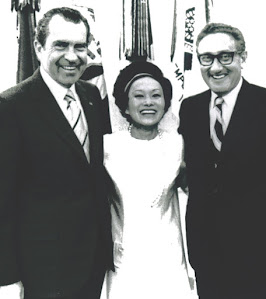
Anna had served as an advisor to Nixon and Secretary of State Henry Kissinger on the region. She had developed close relationships with the top tier of the South Vietnam leadership. When President Johnson halted U.S. bombing of the communist North Vietnam, Anna, two days after Halloween, conveyed to a representative of the South Vietnamese government that it should stall the Paris Peace Talks until after Nixon was elected President, promising a better outcome. Anna received Nixon’s instruction from a longtime friend of Pawley and Anna—Chiang Kai-Shek—according to author George J. Veith in 2022.3

Read more »

Labels: , , , , , , , , , , , , , ,