December 12, 2009

33: Shockwaves

The Kennedy assassination shook the nation, but one of JFK’s friends took it harder than others. When Edward Grant Stockdale’s Irish eyes stopped smiling there may have been more to his depression than was ever revealed.

Stockdale was the former U.S. Ambassador to Ireland. On November 26th, he flew to Washington and talked with Robert Kennedy and Edward Kennedy. Upon his return to Miami, Stockdale told several of his friends that “the world was closing in.” On December 1st, he spoke to his attorney, William Frates, who later recalled their conversation. “He started talking. It didn't make much sense. He said something about ‘those guys’ trying to get him. Then about the assassination.” William Snow Frates and his partners, Peter Thorp Fay and Robert Lester Floyd, coincidentally were the subjects of a December 6th memo seeking CIA covert security approval for the three attorneys “who will be used as officers in KUVEST” which appeared to be a funding mechanism “through notional companies for JMWAVE payroll companies.”1

On December 2, 1963, Grant Stockdale fell to his death from his office window on the thirteenth floor of the exquisite art deco Alfred I. duPont Building, Miami’s first commercial skyscraper at 169 East Flagler Street.2 The building lobby housed a major branch of Florida National Bank & Trust Co. headquartered in Jacksonville which Alfred duPont had purchased in 1929 and named his wife Jessie Ball duPont to the Board of Directors. Upon Alfred’s death in 1935, Jessie’s brother, Ed Ball, took charge of bank through his leadership of the Alfred I. duPont Testamentary Trust.

The Alfred I. duPont Building from which Stockdale plunged should not be confused with the DuPont Plaza Center building at 300 Biscayne Boulevard Way (U.S. 1), Miami, where Life magazine was located on the eighth floor. That building sat at a sharp turn in the road— similar to the Dealey Plaza presidential motorcade route—just before it turns past Bay Front Park where 15,000 family members and friends had gathered waiting for the return of the Cuban exiles involved in the Bay of Pigs invasion.3 Three decades earlier, five shots rang out in Bay Front Park shortly after President-elect Franklin Delano Roosevelt delivered a short speech. The disgruntled, lone-nut, would-be assassin Giuseppe Zangara missed Roosevelt, but five people were struck by bullets and Chicago Mayor Cermak would die later from complications. Zangara died in the electric chair just 14 days after Cermak died.

A rightwing plot—lead by Joseph Milteer of the National States Rights Party—to assassinate President Kennedy with a rifle from an office building in Miami on November 18th was publicly revealed in 1967 as I drove along S.W. 8th Street in Miami after eating breakfast at The Skillet. In 1963, the threat was taken seriously enough by the Secret Service that President Kennedy's motorcade was canceled and instead he and  Senator George Smathers were driven to a helicopter that flew them to Miami Beach where he delivered a speech to the Inter-American Press Association signaling a desire for peace in the Caribbean which was not what Pawley and Cuban exiles wanted to hear.5


JFK and Senator George Smathers at Miami International Airport 11/18/1963 awaiting a helicopter ride after cancelling a motorcade out of security concerns four days before Kennedy was assassinated 1,300 miles away in Dallas. (Photo: Joe Rimkus/State Archives of Florida)


According to FBI reports printed in Don Adams's From an Office Building with A High-Powered Rifle: A Report to the Public from an FBI Agent Involved in the Official JFK Assassination Investigation, the 62-year-old Joseph Adams Milteer from Quitman, Georgia who sometimes lived with a prostitute in Valdosta, Georgia believed John Kennedy, Nikita Kruschev, Martin Luther King and Jewish people were undermining America. (His patriotic zealotry didn't extend to what he drove: a 1962 Volvo and her Volkswagen.)  Milteer had inherited $200,000 from his father and spent it printing pamphlets spreading his segregationist point of view as a member of the White Citizens Council of Atlanta. He supported Strom Thurman for President in 1962 and attended a rally in Fort Lauderdale for Barry Goldwater shortly after revealing his belief that President Kennedy would be shot in Miami from building with a high-powered rifle. Coincidently, the Miami-Fort Lauderdale-Palm Beach Goldwater delegate and the honorary chairman of the Florida Republican Party campaign for Goldwater was William Douglas Pawley. FBI Special Agent Don Adams included in his book a reprint of a photo he had seen in the Harrison Edward Livingstone and Robert J. Groden book High Treason: The Assassination of JFK and the Case for Conspiracy which possibly shows Milteer at Dealey Plaza on November 22, 1963. The picture is odd because Milteer is in a short sleeve shirt while others wear coats and he is taller than many others despite his FBI reported height of 5'4". 

A December 2, 1963 Miami News report stated that Ambassador Grant Stockdale had looked at a Life magazine covering the Kennedy assassination."After smoking a cigarette, he lept out a window, "hitting a ledge eight floors below.” He was to have hosted Senator Ted Kennedy’s visit to Miami on the occasion of the University of Miami’s homecoming ceremony on December 14th. Stockdale was the chairman of the homecoming event, which was cancelled when he died.7 (In 1969, I received my AB degree in American Civilization from the University of Miami.)

Stockdale did not leave a suicide note but Miami Homicide Detective Robert Utes said Pawley’s friend, Senator George Smathers, who had an office in the same building, claimed that Stockdale had become depressed as a result of the death of John F. Kennedy. Stockdale had been Smathers’ administrative assistant in 1946. As word was being spread by the DRE that Oswald was associated with the Fair Play for Cuba Committee, no doubt Smathers recalled that his proposal to cut to U.S. sugar imports from Cuba by 10% was ridiculed in the FPCC's May 13, 1960 Fair Play newsletter under the headline "Sweetening the Bitter Tea of Senator Smathers."     

Read more »

Labels: , , , , , , , , , , , , , , , , , , ,

49: What did Zapruder film?

After filming the fatal head shot to President Kennedy in Frame 313, Abraham Zapruder, standing on the right end of the white wall (just to the right of the Stemmons sign), kept his 8mm camera focused on the limousine as it accelerated down Elm Street in Dallas. 


The Orville Nix film shows Zapruder and his secretary standing on the right end of the wall with the bushy top of a tree a few feet to their left.
 
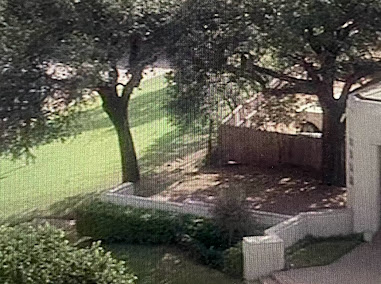
An overhead view shows the white wall, the picket fence, the parking lot behind it, and the road to the left down which JFK's limousine traveled. A small tree has replaced the taller, bushy pyracantha that stood behind Zapruder and the corner of the wall near the road. 

As Zapruder quickly panned past the opposite end of the wall, a figure becomes visible in Frames 412 and 413, but the unidentified man’s full body is hidden by the bushy leaves of a pyracantha that stands between him and Zapruder. Nearby trees cast shadows from the midday sun that further obscure the man’s facial features. 


While projecting the still frame from a bootleg copy of the Zapruder film on my dining room wall, I traced the above image. I also traveled to the grassy knoll to prove that the obscured image in Zapruder Frame 413 could be photographically recreated by standing atop the short white wall in the same spot where Abraham Zapruder had been. 

Then I sent copies stating "This man wasn't hunting quail on11/22/63" to numerous Senators and Representatives in a personal campaign to stimulate a new JFK assassination investigation. 

On October 13, 1976 Representative Henry B. Gonzalez (D-Texas) wrote thanking me for my effort.

Seconds before Frame 413--while everyone focused on Kennedy coming down Elm Street--the sniper could have been kneeling behind this white wall, a vantage point that would have made the coup de grâce virtually a straight shot at the President as he was traveling closer to him—a profoundly far more perfect shot than one from a downward angle six floors up in the School Book Depository as the President was traveling away from what became known as Oswald’s "Sniper’s Perch.” 

Other researchers, such as Gary Shaw, have long argued that the fatal shot to the head came from the front.


The Nix film captures the corner of the wall where the shooter would have been as demonstrated by Gary Shaw. 


On the morning of the President's arrival, the
Dallas Morning News noted that the motorcade would travel through downtown Dallas onto the Stemmons Freeway. The newspaper reported that "the motorcade will move slowly so that crowds can 'get a good closer view' of President Kennedy and his wife. An accompanying diagram showed the path down Elm Street. This gave the crowds and Zapruder reason to be on Elm Street as well as a sniper who wanted to easily hit the target.

After the Warren Commission the path and three shots from the Texas School Book Depository were immortalized in postcards.

Josiah Thompson pointed out in Six Seconds in Dallas, one patrolman soon started running toward the white wall and stockade fence on the grassy knoll.

Former Dallas County Deputy Sheriff, Roger Craig, gave an interview in which he discussed arriving on the scene, seeing the patrolman running toward the fence, what was observed and discovered in the Texas School Book Depository, as well as who told him to keep quiet, and what happened afterwards. 

Sheriff J.E. "Bill" Decker told the police dispatcher at the time of the shooting, "Have my office move all available men out of my office into the railroad yard to try to determine what happened in there and hold everything secure until Homicide and other investigators get there."

The Zapruder film was enhanced by Robert J. Groden before it was aired in March 1975 on ABC-TV’s Good Night America, hosted by Geraldo Rivera. Zapruder Frame 413 also was reproduced in an issue of Rolling Stone magazine. Groden later wrote a book in which the mysterious figure on the grassy knoll was identified by the House Select Committee investigators as “Black Dog Man.” This odd description may have been a result of not realizing that the man was no longer facing the Elm Street—instead turning toward the stockade fence to pass the rifle over the fence and then walk from the crime scene. My interpretation differs in perspective from the indiscernible features of “Black Dog Man.”

On October 30, 1976, I phoned Robert J. Groden, who had enhanced the Zapruder film, to discuss Frame 413 in his first book, JFK: The Case for Conspiracy,which showed a sketch of the individual facing Elm Street. He told me that Manor Books had approached him about doing the book and then had flopped one photo, cropped another, and used their own illustration much to his dismay. He said those involved in the project then left the company and there was no ad budget available to promote the book.

In 1993, Robert Groden produced a more comprehensive photographic book, The Assassination of a Presidentand included a section on “Black Dog Man.” 

This still photo taken by me demonstrates Zapruder’s obscured view in Frame 413 caused by the bushy top of the pyracantha tree when standing on the white wall where he did. My wife is in the center a step away from the stockade fence. Her entire body is hidden by the pyracantha leaves. Only her head and the side of a vehicle on Elm Street can be seen upon closer examination. 

Standing on the wall as Zapruder did, I took this photograph of my 5’3-1/2” wife to demonstrate the height of the stockade fence and how an accomplice in the parking lot on the other side would be virtually unseen. To the left of the corner of the fence is the railroad overpass that the President’s limousine went beneath as it accelerated down Elm Street.

As you can see, a much taller person would be have to be standing behind the picket fence to shoulder the butt of a rifle at a height necessary to hit President Kennedy.

The JFK Assassination Photo Research Galleries website containing 4053 photos and compilations base on films and pictures taken by Zapruder, Nix, Moorman and others. This compilation shows the angle of the fatal headshot from the corner in File 1236. 


In defending the Warren Commission findings, the Rockefeller Commission deceptively focused solely on the inability to hide behind the narrow trunk of the pyracantha (photo taken by me) rather than on how its bushy top obscured Zapruder’s view: “An assassin would be unlikely to hide himself behind the barren trunk of a tree only a few inches in diameter...” 

The Rockefeller Commission then quoted the FBI Laboratory’s statement that “Frames 454 through 478 of the Zapruder film were found to reveal no formation ‘identifiable as a human being or an assassin with a rifle or other weapon.”

An unidentified dark figure was photographed walking away from the crime scene area by railroad worker Richard Bothun. He is behind the white wall heading in the direction of the Texas School Book Depository, a considerable distance from where Frame 413 was taken. Bothun's "shadow man" is pictured just above and to the right of the two men sitting on the curb. 


Some have pondered why the two men remained sitting on the Elm Street curb while so many others explored the knoll, even running to the picket fence area in the opposite direction from where the "shadow man" was headed.

A number of unidentified people were questioned that day including "three tramps" that a decade later some mistakenly believed looked like Watergate burglars. And an unnamed man was placed in the backseat of a police cruiser.


When Jim Garrison looked into the assassination in the late 1960s, one witness was Mary Moorman who took a Polaroid picture of the crime while looking toward the grassy knoll where the other witness, James Simmons said he saw "a puff of smoke." 


Was the shooter on a mission from Viet Nam seeking revenge for the November 2, 1963 murder of Ngo Dihn Diem? 

Or from the Congo where Patrice Lumumba perished in 1961 after the CIA Director Allen Dulles compared him to Castro and discussed options with Agency personnel Thomas Parrot, Bronson Tweedy, Richard Bissell, Sydney Gottlieb and Lawrence Devlin?  

Or was the hitman sent by the Mafia which had grown impatient with its ability to get casinos in Cuba reopened and angry with Robert Kennedy's crackdown on them in the United States? 

Or was it a pro- or anti-Castro plot fueled with anger at JFK? 

Would his dark features—like over 30% of Cubans—have ruled him out as a suspect in 1963 because President Kennedy had given impetus to the civil rights movement and angered ultra-conservative segregationists in March 1963 by calling “for new measures to protect Negro rights in voting, schools and jobs.”4

No doubt segregationists—like Senator James Eastland who was the Federal official most likely to conduct an investigation of the assassination as an internal security matter, not Chief Justice Earl Warren whom President Johnson named—would have proclaimed the sniper was proof that the civil rights movement was backed by communist enemies of America—a frequent accusation at the time according to an editorial that appeared in the Deseret News one month after the assassination.5

If a pro-Castro Cuban or American was arrested on the grassy knoll, those who proposed Operation Northwoods would have rejoiced, finally having their justification for the U.S. invading Cuba and toppling Castro. Would Castro not realize this?

If the sniper was an anti-Castro exile, a cover-up would have been necessary to distance him from those in the CIA or other agencies that had been in contact with him or his friends. His motive would have been revenge for the lack of air cover that caused the failure at the Bay of Pigs and perhaps his own imprisonment or the death of a beloved parent or relative.

If he had been captured at the Bay of Pigs, how grateful—and owing— would he have felt to those who financially expedited the ransom negotiations that freed him?

If he were among the 300 Cuban exiles working out of Pawley’s office after the Bay of Pigs, would he have been so aroused by the ultra-conservative former Latin American Ambassador’s private and public rhetoric that the exile took the initiative to rid the nation of the president standing in the way of the swift defeat of communism?

Perhaps the mystery man was simply a soldier of fortune recruited from the sugar cane fields or the ranks of the unemployed military by a Milteer-type segregationist or some wealthy conservative who feared that Kennedy had made a pact with the communists that would doom the U.S.

On November 27, 1963, Secret Service agent Paul Landis who was part of the President's motorcade gave a statement for the record to the United States Treasury. He said he believed a shot had come from the front and he "looked along the right side of the road ... the only person I recalled seeing was a negro male in light green slacks and a beige colored shirt running across a grassy section towards some concrete steps and what appeared to be a low stone wall. He was in a bent over position, I did not notice anything in his hands." 

Nearly 60 years later, Landis raised eyebrows (even among the mainstream media) when he revealed that he had found a nearly pristine bullet in JFK's limousine and placed it on his stretcher, putting the Warren Commission's claim that the same bullet found on Connally's stretcher had magically caused multiple wounds to the President and Connally. Landis reasserted that he thought there was a shot from the front which was consistent with Parkland Hospital's Dr. Robert McClelland's 2015 statement that is available at Jefferson Morley's JFK Facts September 15, 2023 substack.

NEXT CHAPTERS:


Read more »

Labels: , , , , , , , , , , , , , , ,