As male baby boomers, like myself, graduated high school in record numbers and faced the possibility of
being drafted and sent to Southeast Asia, Americans focused more on the escalating war in Viet
Nam than the threat in the Caribbean. And Pawley’s dire warnings about Cuba got less and less
ink.
It was a turbulent time in America. On April 4, 1968, civil rights leader, Martin Luther
King, was assassinated by another “lone gunman,” James Earl Ray. Riots broke out across
America. White flight from the inner cities separated the human race even more. Two months
after delivering an eloquent speech calling for calm and reconciliation in the wake of Dr. King’s
murder, Presidential candidate, Robert F. Kennedy, was assassinated by yet another loner, Sirhan
Sirhan.1
In July, Pawley was honored for his glory days in China. “Bill Pawley received the first
CNAC Award for contribution to aviation in China” at a reunion of the CNAC and Flying Tiger
“‘Old China Hands.’” He gave a rousing banquet speech to the attendees including Edna Pawley,
his brothers, Gene and Ed, and their wives.” Eugene Pawley first went to China in 1939, returned
in June 1942 to drive CNAC supplies, then switched over to intelligence, heading the OSS China
Desk. Ed helped organize the Flying Tigers, while Bill built planes. The celebrity attraction at
the CNAC event was 1950s heavyweight champion boxer Rocky Marciano, who ironically died
the following year in an airplane crash. One of the other CNAC Award highlights was a party
hosted by Edna and William Pawley at their Miami home during which they gave the attendees a
cruise on Biscayne Bay aboard his Flying Tiger yacht.
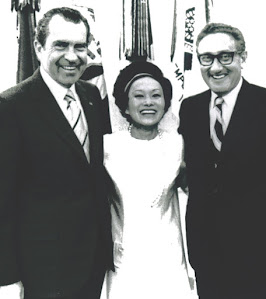
Anna Chennault, widow of the Flying Tiger leader General Claire Chennault, sent a letter
of regret that she could not attend the July 22, 1968 event “due to urgent business matter I have
to leave for the Far East and Southeast Asia.”2
Anna had served as an advisor to Nixon and Secretary of State Henry Kissinger on the region. She had developed close relationships
with the top tier of the South Vietnam leadership. When President Johnson halted U.S. bombing
of the communist North Vietnam, Anna, two days after Halloween, conveyed to a representative
of the South Vietnamese government that it should stall the Paris Peace Talks until after Nixon
was elected President, promising a better outcome. Anna received Nixon’s instruction from a
longtime friend of Pawley and Anna—Chiang Kai-Shek—according to author George J. Veith in
2022.3
Read more »Labels: Anna Chennault, CIA, CNAC, Corcoran, Curtis LeMay, Flying Tiger, GeorgeTown Club, Helms, LBJ, Pawley, Robert F. Kennedy, Sirhan Sirhan, Smathers, Tongsun Park, Vietnam